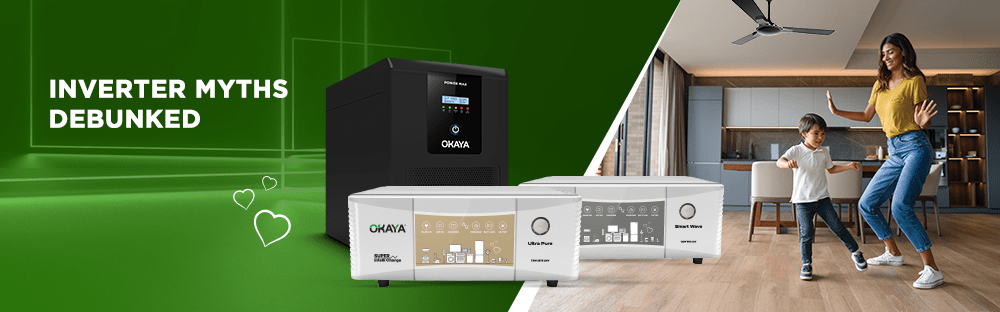
A home inverter does add a small amount to your electricity bill during battery charging — but for most Indian homes, this addition is modest and predictable, not the dramatic spike people often assume. How much it adds depends mainly on the charging technology used, the battery's capacity and condition, and how often the home actually runs on backup power, not on the simple fact that an inverter is installed.
Fact: An inverter draws grid power mainly to recharge its battery. Once the battery is charged, the inverter's grid draw drops significantly — a small amount of power may still be used for standby operation and for maintaining the battery at full charge, but this is minor compared to running appliances like air conditioners or geysers directly. So a well-matched inverter for your home adds only a modest, predictable amount to a typical monthly bill.
Fact: Charging efficiency depends on the inverter's underlying technology. Okaya's current inverter for home and high-capacity range is built on Advanced True Sine Wave (ATSW) technology, designed to provide clean, stable power output, while features such as Super Intelli Charge and the energy-efficient EI Core help improve charging performance and reduce power loss during recharging. This is different from older, less efficient technologies that some inverters in the market still use — the type of technology inside the unit matters more than the mere presence of an inverter.
Explore the full inverter capacity and wattage range built on ATSW technology (also available as a Home UPS lineup).
Fact: What affects your bill is how much load the inverter actually supports and how long it charges — not the capacity rating sitting unused. A high-capacity inverter sized correctly for a large home, shop, or office running heavier equipment is not automatically more expensive to run than an undersized unit struggling to support the same load. Sizing the inverter to the home's real requirement, rather than guessing, is what keeps charging efficient.
If you are unsure which capacity fits your home, our load-based inverter sizing guide walks through how to calculate this correctly.
Fact: Modern inverter charging is not a fixed, constant draw. Charging current is higher when the battery is significantly discharged and reduces as the battery approaches full charge; once full, the system moves into a float stage that maintains the charge rather than continuing to draw at the same rate. This is also why Okaya inverter batteries are built with XBD+ (Xtra Backup Design Plus) for improved charging response, and carry Certified Backup Hours (CBH) — tested runtime values verified by NABL-accredited laboratories and printed on the packaging — so homeowners can plan around a verified backup figure instead of estimating usage and consumption.
1. The inverter's charging technology and output waveform quality
2. Battery capacity and its charging efficiency as it ages
3. How often and how long the home actually runs on backup power
4. Whether the inverter and battery are correctly sized for the home's load, rather than oversized or undersized
Browse the inverter for home range or the high-capacity inverter range on shop.okaya.in to compare models suited to your home's load, or check the inverter and battery combo options if you're setting up a new inverter and battery together for the first time.
Rather than worrying about whether an inverter itself increases electricity costs, the more useful question is whether the current setup is right for the home. A unit that is undersized runs harder and charges more often; one that is oversized for a small home adds unnecessary upfront cost without a proportional backup benefit.
For a deeper look at pairing inverter technology with everyday home efficiency, see Optimizing Home Energy: The Okaya Inverter Guide and Smart Home Inverters: Latest Technologies for Better Efficiency.
You can also explore the full inverter for home range or the high-capacity inverter range (Home UPS and Hi-Capacity UPS respectively) to find a model matched to your home or workspace, or browse the complete inverter and UPS range directly on shop.okaya.in.
An inverter is not the electricity-bill culprit it is often made out to be. The actual impact on a monthly bill depends on the technology inside the unit, how well it is sized to the home, and how efficiently it charges — factors that are within a buyer's control, not a fixed cost of owning an inverter.
Rather than relying on assumptions about backup and consumption, Okaya's approach is to make these figures verifiable — Certified Backup Hours (CBH) are tested under defined load conditions and validated by NABL-accredited laboratories, so homeowners can check the numbers on the packaging instead of estimating them.
Does an inverter increase my electricity bill?
Yes, marginally — most of the additional electricity use comes from recharging the battery. A small amount may also be consumed in standby operation and while maintaining the battery's charge. The size of the increase depends on the battery capacity and how often it needs recharging.
How many units of electricity does an inverter consume per day?
This varies by battery capacity, how discharged the battery is when charging starts, and the inverter's charging efficiency, so there is no single fixed figure that applies to every home. A battery that is only partially discharged during a short outage takes less energy to top up than one that has been deeply discharged over a long outage.
Does inverter battery charging cost more at night than during the day?
The electricity used to charge an inverter battery is the same regardless of the time of day — what changes any actual cost is your local electricity tariff structure, if your provider charges different per-unit rates at different times, not anything about how the inverter itself charges.
What are the most effective ways to reduce electricity costs linked to a home inverter or UPS?
Choosing a correctly sized Home UPS or Hi-Capacity UPS for your actual load, avoiding unnecessary oversizing, and using an inverter built with efficient charging features (such as Super Intelli Charge and a power-loss-reducing EI Core) are the main levers. Keeping the battery in good health also helps, since a deteriorating battery can take longer to charge and draw more energy to reach full charge.
Does a higher-capacity inverter draw more power while charging?
Not by VA rating alone — an inverter's VA rating describes how much load it can support, not how much energy it draws while charging. Actual charging energy depends on the charger's design, the battery's capacity, how discharged the battery is when charging starts, the connected load, and system losses. A correctly sized Hi-Capacity UPS charging to support a larger home's load is not wasteful compared to an undersized unit working harder to cover the same requirement.
 OKAYA POWER PVT. LTD.
ENERGIS D-7, 3rd & 4th Floor, Rohtak Rd,
Udyog Nagar, Mangolpuri,
New Delhi - 110041, INDIA
OKAYA POWER PVT. LTD.
ENERGIS D-7, 3rd & 4th Floor, Rohtak Rd,
Udyog Nagar, Mangolpuri,
New Delhi - 110041, INDIA
© 2026 All Rights Reserved to Okaya Power Private Limited