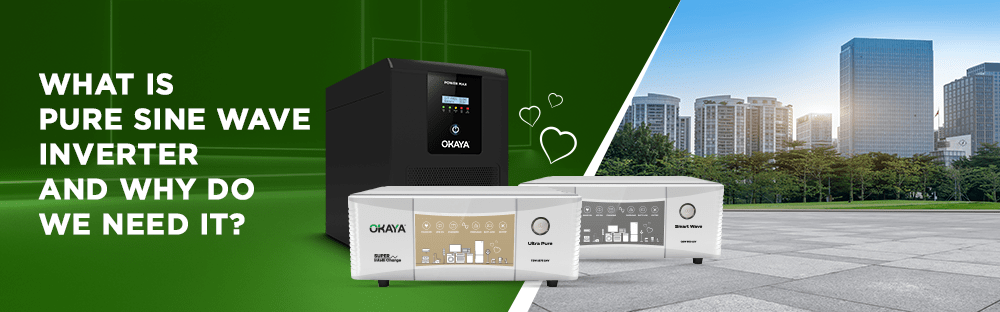
In a world where dependence on electrical appliances keeps growing, a reliable power backup solution matters more than ever. Power outages disrupt daily routines, and the quality of power your backup supplies can matter as much as its availability. This is where the pure sine wave inverter becomes important, especially in areas where power cuts are frequent. This guide explains what a pure sine wave inverter is, how it compares to modified/square wave alternatives, and why it matters for your appliances — with a look at Okaya's Advanced True Sine Wave (ATSW) technology.
A pure sine wave inverter is a power backup system that converts direct current (DC) from a battery into alternating current (AC) — the form of electricity that powers most home and commercial appliances. What sets it apart is the shape of that AC output: it produces smooth, consistent oscillations and steady voltage that closely mirror the quality of grid power, rather than the rougher, stepped waveform produced by lower-cost inverter designs.
Not all inverters produce the same waveform, and this is one of the most common points of confusion when comparing inverters across brands:
Pure/True Sine Wave: A smooth, continuous waveform that closely matches grid power — suitable for a wide range of appliances, including sensitive and motor-based electronics, when the inverter is correctly sized for the load.
Modified Sine Wave (also called Quasi-Sine Wave / QSW): A stepped approximation of a sine wave. It costs less to produce but can cause some appliances — especially those with motors, compressors, or sensitive electronics — to run less efficiently, run hotter, or in some cases get damaged over time.
Square Wave: The most basic and least refined output, generally unsuitable for modern home appliances and largely phased out in quality inverters.
Okaya's current Home UPS and Hi-Capacity UPS ranges use Advanced True Sine Wave (ATSW) technology, replacing the older QSW positioning in the current lineup — so today's Okaya inverters ship with true sine wave output rather than the earlier QSW approximation.
For a fuller side-by-side breakdown, see our Sine Wave Vs Square Wave Inverter comparison.
Why a True Sine Wave Inverter Is Superior
Okaya's Advanced True Sine Wave (ATSW) technology, used across its pure sine wave inverter range, is built to deliver output that outperforms modified sine wave and square wave alternatives in several key ways:
Longevity of Appliances: A true sine wave output does not subject appliances to the electrical stress that a stepped or modified waveform can cause, supporting normal appliance lifespan.
Quality of Power: Smooth, repetitive oscillations and steady voltage, closely matching grid-quality power — suitable for both home and commercial use.
Versatility: True sine wave inverters are compatible with a wide range of electronics, electrical appliances, and consumer durables, including motor-based and sensitive equipment.
Okaya's Pure Sine Wave inverters are built on Advanced True Sine Wave (ATSW) technology, engineered to deliver clean, stable output rather than the stepped approximation used in lower-cost modified sine wave units.
Energy Efficiency: A specially designed EI core helps minimize power loss during operation, reducing wasted energy and heat generation.
Super Intelli Charge: An advanced charging profile designed to support efficient charging and battery health.
Load Handling: Okaya's Home UPS and Hi-Capacity UPS ranges are engineered to handle a wide range of home and commercial loads.
Is a Pure Sine Wave Inverter Worth It?
For most Indian homes running fans, lights, TVs, routers, and kitchen appliances, a pure sine wave inverter is the safer long-term choice over a modified sine wave unit. The difference matters most with motor-based appliances (fans, mixers, refrigerator compressors, water pumps) and sensitive electronics (routers, laptops, LED TVs, medical or audio equipment) — these run more efficiently and safely on a true sine wave output. A modified sine wave inverter may cost less upfront, but can shorten appliance life or cause certain devices to run inefficiently or noisily over time.
An Okaya Pure Sine Wave Inverter is built for reliable, appliance-safe power backup for the modern household — combining ATSW output quality with Super Intelli Charge and EI-core efficiency. Browse the Home UPS range or the Hi-Capacity UPS range on shop.okaya.in, or read our guide to choosing the best sine wave inverter for your home for model-by-model guidance.
Conclusion
A pure sine wave inverter is more than a power backup component — the waveform quality it delivers directly affects how safely and efficiently your appliances run. Okaya's Advanced True Sine Wave (ATSW) technology is built to deliver consistent, grid-like power quality, making it a dependable choice for homes and small businesses looking to protect their appliances during outages.
What makes a Pure Sine Wave Inverter from Okaya different from other inverters in the market?
An Okaya Pure Sine Wave Inverter is built on Advanced True Sine Wave (ATSW) technology, providing a consistent, steady power output that closely resembles grid power — unlike modified sine wave inverters, which produce a stepped approximation. Okaya inverters also feature a power-loss-reducing EI core, the Super Intelli Charge charging profile that supports efficient charging and battery health, and load handling built for a range of home and commercial appliances.
Can Okaya Pure Sine Wave Inverters safely power sensitive electronic devices?
Yes. A true sine wave output maintains a consistent voltage and smoothly changing phase angle, which is important for the safety and longevity of sensitive electronics such as routers, laptops, LED TVs, and audio/video equipment. This is one of the key reasons true sine wave output is generally preferred over modified sine wave for such devices.
How is a pure sine wave inverter different from a modified sine wave (quasi-sine wave) inverter?
A pure sine wave inverter produces a smooth, continuous waveform closely matching grid power, while a modified/quasi-sine wave (QSW) inverter produces a rougher, stepped approximation. Modified sine wave units typically cost less but can cause certain appliances — especially those with motors or compressors — to run less efficiently, run hotter, or wear down faster over time. Okaya's current Home UPS and Hi-Capacity UPS ranges use Advanced True Sine Wave (ATSW) technology, replacing the older QSW positioning in the current lineup.
Can a pure sine wave inverter run a refrigerator safely?
Yes. A pure sine wave inverter is generally recommended for refrigerators because compressors are motor-based and have a high startup surge. The inverter must also be correctly sized to handle the refrigerator's starting and running load — waveform quality alone does not substitute for adequate VA/surge capacity.
Is a pure sine wave inverter worth the extra cost over a modified sine wave or square wave inverter?
For most homes, yes. While a pure sine wave inverter can cost more upfront than a modified sine wave or square wave unit, it reduces the risk of appliance stress, inefficient running, or long-term damage — particularly for motor-based appliances and sensitive electronics. For a basic setup running only a few simple loads (like lights alone), the difference is less critical, but for a typical home with mixed appliances, pure sine wave is the safer choice.
How does an Okaya Pure Sine Wave Inverter contribute to energy efficiency?
The specially designed EI core in Okaya's ATSW inverters minimizes power loss, reducing wasted energy and heat production during operation. The Super Intelli Charge feature also supports efficient charging and battery health, helping optimize overall power usage.
 OKAYA POWER PVT. LTD.
ENERGIS D-7, 3rd & 4th Floor, Rohtak Rd,
Udyog Nagar, Mangolpuri,
New Delhi - 110041, INDIA
© 2026 All Rights Reserved to Okaya Power Private Limited