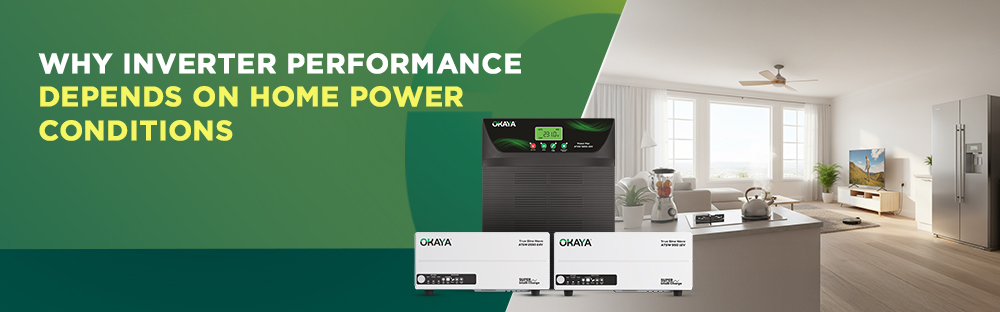
Inverter performance is often judged by backup time or how smoothly appliances run during a power cut. However, the same inverter can feel different in different situations—not because the inverter is weak, but because the power conditions inside a home shape how the system behaves.
An inverter works as part of a complete power setup that includes appliances, wiring, and battery configuration. When these conditions change, the way backup power is experienced also changes.
This blog explains why inverter performance depends on home power conditions, what factors influence real-world backup behaviour, and how inverter performance should be understood correctly.
| Sr. No. | Table of Contents |
| 1 | Inverter Performance Is a System Outcome |
| 2 | Home Power Usage Shapes Backup Behaviour |
| 3 | Appliance Load and Power Draw Patterns |
| 4 | Wiring Quality and Electrical Stability |
| 5 | Battery Configuration and Charging Conditions |
| 6 | Interpreting Inverter Performance Correctly |
| 7 | FAQs |
| 8 | Conclusion |
An inverter does not operate independently. It responds to the electrical conditions inside a home during a power cut. This includes how many appliances are connected, how power is drawn, and how the electrical system supports the inverter during operation.
Because every home has a different power environment, inverter performance should always be seen as the result of how the system is used, not just the inverter’s specifications.
Power usage varies from one home to another. Some homes use lighting and fans for longer hours, while others rely heavily on internet devices, work setups, or additional appliances during outages.
When more appliances run at the same time, the inverter has to handle higher load, which affects backup duration and stability. This is why inverter performance depends strongly on how power is consumed during a power cut, not just on inverter capacity.
Appliances consume electricity differently. Certain appliances draw extra power at the moment they start, even if their normal running consumption is lower.
When multiple appliances start together, the inverter experiences a temporary increase in load. This can make backup feel shorter or less stable, even though the inverter is operating within its designed limits. These load patterns are a normal part of home power behaviour.
Home wiring plays a critical role in inverter performance. Proper wiring allows electricity to flow smoothly from the inverter to connected appliances. Poor connections, voltage drops, or older wiring layouts can cause power loss and affect how backup is delivered.
Homes with stable wiring and correct inverter connections usually experience smoother and more consistent backup compared to homes where electrical conditions create resistance or imbalance.
While the inverter manages power delivery, the battery determines how long backup lasts. Battery capacity, age, charging level, and compatibility with the inverter all influence real-world performance.
If the battery is undersized, not fully charged, or nearing the end of its service life, backup duration may feel shorter. Proper battery selection and charging conditions are essential for consistent inverter performance.
Inverter performance should not be judged by backup time alone. It should be understood by how smoothly the system handles load changes, maintains voltage stability, and supports appliances during real usage conditions.
When an inverter is selected based on actual power needs and supported by proper wiring and battery configuration, performance remains predictable and reliable. Differences in home power conditions explain why performance can feel different in everyday use.
No. Performance differences are usually caused by home power conditions such as load patterns, wiring quality, and battery setup.
Yes. Changes in appliance usage, battery condition, or electrical setup can influence how backup is experienced.
Not necessarily. Correct sizing based on actual power requirements is more important than choosing a higher capacity.
Wiring quality is very important. Stable wiring supports smoother power delivery during backup.
Yes. Battery capacity, health, and charging condition directly affect backup duration and stability.
Inverter performance depends on home power conditions because every home operates as a unique electrical environment. Load behaviour, appliance usage, wiring quality, and battery configuration together shape how backup power is experienced during an outage.
Understanding these factors helps set realistic expectations and ensures inverter performance is evaluated correctly. When the system is selected and configured thoughtfully, backup power remains reliable and consistent with actual needs.
 OKAYA POWER PVT. LTD.
ENERGIS D-7, 3rd & 4th Floor, Rohtak Rd,
Udyog Nagar, Mangolpuri,
New Delhi - 110041, INDIA
OKAYA POWER PVT. LTD.
ENERGIS D-7, 3rd & 4th Floor, Rohtak Rd,
Udyog Nagar, Mangolpuri,
New Delhi - 110041, INDIA
© 2025 All Rights Reserved to Okaya Power Private Limited