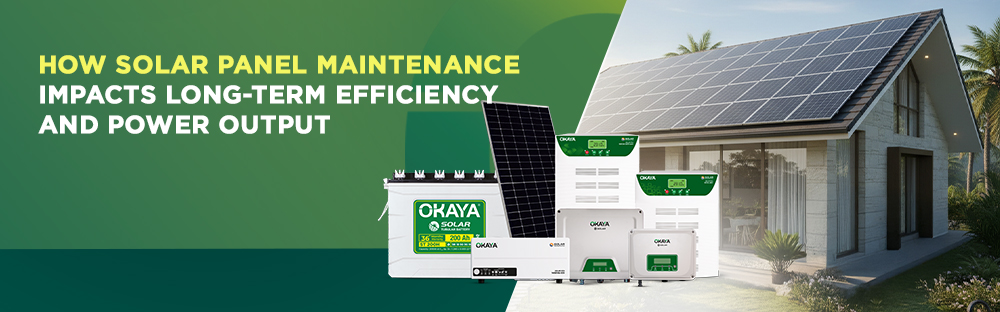
Solar panel maintenance plays a quiet but important role in long-term efficiency and power output. In most cases, it does not require technical knowledge or frequent attention. Simple and regular care is usually enough to help solar panels maintain steady performance over time. In solar systems, maintenance is best seen as a normal part of ownership rather than a complex or demanding task.
This blog is for homeowners and businesses who want to understand how basic upkeep affects performance, why maintenance is manageable, and how solar output typically changes over the years.
Solar panels generate electricity when sunlight reaches their photovoltaic cells directly. Over time, dust, pollution, and natural debris can settle on the panel surface. This does not stop the system from working, but it reduces the amount of sunlight reaching the cells.
The result is usually a slow and gradual drop in output, not a sudden failure. Because this change happens over time, many users do not notice it unless they regularly track energy generation. Basic maintenance helps control this gradual efficiency loss and keeps power generation more consistent.
Solar panels are designed to operate outdoors for many years. Maintenance does not involve daily monitoring or technical handling. In most residential setups, especially solar panel for home installations, maintenance mainly means keeping the panel surface clean and free from obstructions.
For a typical home solar panel system, routine care is similar to general home upkeep. This simplicity is one of the reasons solar remains a practical long-term energy solution.
Solar panels depend entirely on sunlight exposure. When dust or debris partially covers the panel surface, electricity is still generated, but at a lower level. Over time, this reduction can lead to noticeable differences in annual energy output.
Simple visual checks and occasional cleaning help ensure that panels receive consistent sunlight. This is especially important in urban and semi-urban areas, where airborne dust is more common.
Cleaning improves surface-level efficiency, but long-term reliability also depends on the system working smoothly as a whole. The electricity generated by panels flows into connected components such as on-grid inverters or off-grid solar PCUs. These components operate best when panel output is stable.
Occasional inspections, usually done by trained professionals, help ensure that mounts and connections remain secure. These checks are preventive in nature and are not frequent or disruptive.
When solar panels receive no maintenance at all, performance typically declines slowly. Users may notice slightly lower generation figures over time, rather than a clear system fault. This does not mean the system has failed. It simply means it is no longer operating at its optimal level.
Basic maintenance helps avoid this silent efficiency loss and supports stable long-term energy generation.
Solar systems work as integrated units. When panel output remains stable, connected components such as a solar battery can operate more smoothly. Stable generation supports balanced charging cycles and overall system stability.
From this perspective, maintenance exists to preserve system balance and reliability rather than to fix problems after they appear.
When users explore solar panel price in India, installation cost is only part of the decision. Long-term performance matters just as much. Understanding basic maintenance expectations early helps users set realistic output and performance goals.
For new buyers, a detailed home solar panel buying guide explains selection, installation, and ownership considerations clearly and practically.
Once the role of maintenance in long-term performance is clear, the next step is reviewing suitable panel options. Users planning to buy solar panels online can compare configurations based on their energy needs and usage patterns.
No. Basic maintenance involves visual checks and occasional cleaning. Technical inspections are infrequent and handled by professionals.
Yes, but output may gradually decline over time if panels are completely ignored.
Dirt reduces the amount of sunlight reaching the cells, leading to lower electricity generation.
Environmental conditions make periodic cleaning more relevant, but the process remains simple.
Indirectly, yes. Stable panel output helps connected inverters operate efficiently.
Routine maintenance is minimal and mainly preventive, helping protect long-term performance.
 OKAYA POWER PVT. LTD.
ENERGIS D-7, 3rd & 4th Floor, Rohtak Rd,
Udyog Nagar, Mangolpuri,
New Delhi - 110041, INDIA
OKAYA POWER PVT. LTD.
ENERGIS D-7, 3rd & 4th Floor, Rohtak Rd,
Udyog Nagar, Mangolpuri,
New Delhi - 110041, INDIA
© 2025 All Rights Reserved to Okaya Power Private Limited