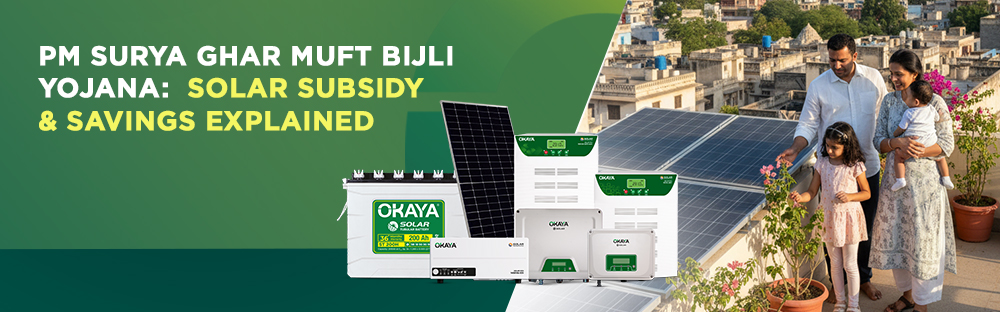
PM Surya Ghar Muft Bijli Yojana is a Government of India rooftop solar subsidy scheme designed to make residential solar installations more affordable. Under this scheme, eligible homeowners receive direct financial subsidies for installing rooftop solar systems, helping reduce upfront costs and lower monthly electricity bills over time.
The scheme primarily supports grid-connected rooftop solar systems and encourages households to generate their own electricity, reduce dependence on grid power, and benefit from long-term energy savings when systems are planned correctly.
This blog explains the PM Surya Ghar Muft Bijli Yojana in a practical, easy-to-understand way so homeowners can make informed solar decisions. It covers:
1. What is PM Surya Ghar Muft Bijli Yojana and how it works
2. How much rooftop solar subsidy is available
3. Who is eligible for government solar subsidies
4. How to apply for solar subsidy in India
5. What a complete solar solution includes
6. The role of panels, inverters, PCUs, and batteries
7. The difference between on-grid and off-grid solar systems
8. How proper system planning improves long-term energy utilisation
PM Surya Ghar Muft Bijli Yojana is a central government initiative aimed at accelerating rooftop solar adoption across India. The scheme reduces the financial barrier to solar installation by offering direct subsidies that are credited to the homeowner’s bank account after system installation and approval.
By lowering the upfront cost, the scheme enables more households to adopt solar power while supporting India’s broader clean energy and sustainability goals.
Under the PM Surya Ghar Yojana, residential rooftop solar users can avail:
1. ₹30,000 per kW for systems up to 2 kW
2. ₹18,000 per kW for additional capacity between 2 kW and 3 kW
3. A maximum subsidy of approximately ₹78,000 for systems above 3 kW
4. ₹18,000 per kW subsidy for Group Housing Societies and RWAs for common facilities, including EV charging, up to approved capacity limits
In addition to central subsidies, some states offer additional incentives. Since subsidy structures may change, homeowners should always confirm the latest rates with MNRE and their local DISCOM.
To qualify for subsidies under PM Surya Ghar Muft Bijli Yojana, homeowners must:
1. Have a valid residential electricity connection
2. Own or legally occupy the property
3. Have suitable rooftop space for solar panels
4. Install the system through an MNRE-approved vendor
5. Use components that comply with government standards
6. Install On-Grid or Hybrid System, with DCR Panel
Choosing quality solar panels that meet certification norms is important for both subsidy eligibility and long-term performance.
The application process is structured and transparent:
1. Register on the official PM Surya Ghar portal and select your DISCOM
2. Choose an MNRE-empanelled solar installer
3. Upload required documents such as ID proof, property proof, and electricity bill
4. After installation, the system is inspected by the DISCOM
5. Once approved, the subsidy is credited directly to your bank account
Okaya supports customers by assisting with coordination, documentation guidance, and government-compliant installations.
A complete residential solar solution includes multiple components working together:
1. Solar panels to generate electricity
2. Inverters or Solar PCUs to regulate and convert power
3. Solar batteries (optional) to store energy for backup
4. Safety, protection, and mounting equipment
Together, these components ensure efficient power generation, reliable supply, and long-term system stability.
Solar subsidy reduces the upfront installation cost, but the real benefit comes from long-term electricity savings. By generating power on the rooftop, households reduce dependence on grid electricity and lower monthly bills.
Solar system performance depends on how well its components work together:
1. Panels generate DC power from sunlight
2. Inverters or Solar PCUs manage conversion and power flow
3. Batteries store excess energy for later use
Understanding how these elements interact helps homeowners plan systems that deliver consistent performance.
You can also explore specific system options here:
Beyond subsidy and bill savings, rooftop solar systems offer:
1. Clean and renewable energy
2. Reduced carbon footprint
3. More predictable electricity costs
4. Improved energy independence
5. Long-term value addition to residential properties
Okaya solar power systems are engineered to meet Indian household requirements while ensuring performance, safety, and government compliance.
PM Surya Ghar Muft Bijli Yojana makes solar adoption more accessible, but long-term benefits depend on correct system planning. Instead of focusing only on subsidy or installation cost, homeowners should evaluate system quality, component compatibility, and long-term performance.
A well-planned solar system delivers consistent savings, reliable power, and sustainable energy benefits over its lifetime.
Subsidy can go up to approximately ₹78,000 depending on system capacity.
Residential property owners with valid electricity connections and MNRE-approved installations.
Applications are made online through the official portal, followed by installation and inspection.
Solar panels, inverters or PCUs, batteries (if required), and safety equipment.
Subsidy lowers upfront costs, while long-term savings depend on system design and energy usage.
 OKAYA POWER PVT. LTD.
ENERGIS D-7, 3rd & 4th Floor, Rohtak Rd,
Udyog Nagar, Mangolpuri,
New Delhi - 110041, INDIA
OKAYA POWER PVT. LTD.
ENERGIS D-7, 3rd & 4th Floor, Rohtak Rd,
Udyog Nagar, Mangolpuri,
New Delhi - 110041, INDIA
© 2025 All Rights Reserved to Okaya Power Private Limited