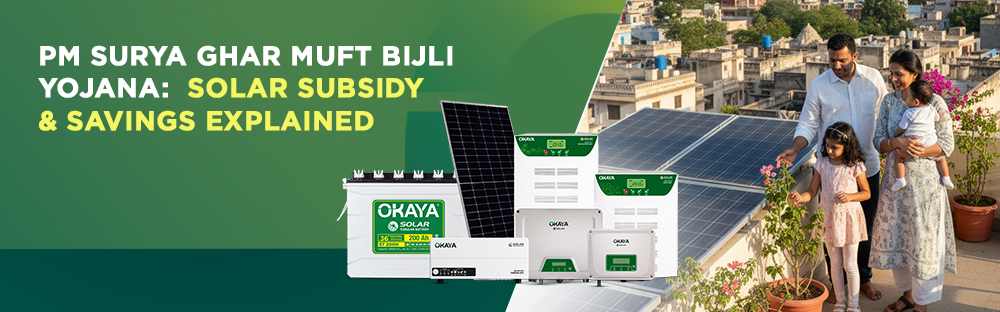
PM Surya Ghar Muft Bijli Yojana is a Government of India rooftop solar subsidy scheme designed to make residential solar installations more affordable. Under this scheme, eligible homeowners receive direct financial subsidies for installing rooftop solar systems, helping reduce upfront costs and lower monthly electricity bills over time.
The scheme primarily supports grid-connected rooftop solar systems and encourages households to generate their own electricity, reduce dependence on grid power, and benefit from long-term energy savings when systems are planned correctly.
PM Surya Ghar Muft Bijli Yojana is a central government initiative aimed at accelerating rooftop solar adoption across India. The scheme reduces the financial barrier to solar installation by offering direct subsidies that are credited to the homeowner's bank account after system installation and approval.
By lowering the upfront cost, the scheme enables more households to adopt solar power while supporting India's broader clean energy and sustainability goals.
Under the PM Surya Ghar Yojana, residential rooftop solar users in General States/UTs can avail:
A. Rs 30,000 per kW for systems up to 2 kW
B. Rs 18,000 per kW for additional capacity between 2 kW and 3 kW
C. A maximum subsidy of Rs 78,000 for systems above 3 kW, as the subsidy is capped at 3 kW capacity
D. Rs 18,000 per kW for Group Housing Societies and RWAs for common facilities, including EV charging, up to 500 kW capacity (at 3 kW per house)
For Special Category States/UTs, the CFA is Rs 33,000/kWp for the first 2 kW and Rs 19,800/kWp for the additional capacity up to 3 kW, giving a maximum CFA of Rs 85,800 (Rs 19,800 per kW for RWA/GHS common facilities). Check the latest applicable rate on the PM Surya Ghar portal.
In addition to central subsidies, some states offer additional incentives. Since subsidy structures may change, homeowners should always confirm the latest rates with MNRE and their local DISCOM.
|
System size |
Central subsidy (General States/UTs) |
|
1 kW |
Rs 30,000 |
|
2 kW |
Rs 60,000 |
|
3 kW |
Rs 78,000 (Rs 60,000 + Rs 18,000) |
|
Above 3 kW (for example 4 kW or 5 kW) |
Capped at Rs 78,000 |
This means that in General States/UTs a 4 kW system gets the same central subsidy as a 3 kW system. Whether a larger system is worth it depends on your electricity use and roof space, so size the system to your consumption rather than to the subsidy.
To qualify for subsidies under PM Surya Ghar Muft Bijli Yojana, homeowners must:
A. Be an Indian citizen who owns a house with a roof suitable for solar panels
B. Have a valid residential electricity connection
C. If CFA/subsidy has already been availed for an existing rooftop solar system, additional CFA may be available only for eligible added capacity within the scheme limits
A. Install the system through a vendor registered on the PM Surya Ghar National Portal
B. Use components that comply with government standards
C. Install an eligible grid-connected rooftop solar system using DCR modules. Approved behind-the-meter or battery-hybrid systems may also qualify, subject to applicable State/UT electricity regulations. Off-grid installations are not eligible for the subsidy
DCR (Domestic Content Requirement) panels are solar cells and modules manufactured in India, and only such panels qualify for the subsidy. Okaya offers both DCR and non-DCR solar panels, so check that the model you choose is DCR if you plan to claim the subsidy. Choosing panels that meet certification norms is important for both subsidy eligibility and long-term performance.
The application process is structured and transparent:
A. Register on the official PM Surya Ghar portal and select your state and DISCOM
B. Choose a vendor registered on the PM Surya Ghar National Portal
C. Upload required documents such as ID proof, property proof, and electricity bill
D. After installation, the system is inspected by the DISCOM
E. Once approved, the subsidy is credited directly to your bank account
Okaya assists customers in coordinating with approved vendors for installation and subsidy claims.
A complete residential solar solution includes multiple components working together:
A. Solar panels to generate electricity
B. Inverters or solar PCUs to regulate and convert power. Off-grid PCUs include the solar charge controller, and grid-connected systems use on-grid inverters.
C. Solar batteries (optional) to store energy for backup
D. Safety, protection, and mounting equipment
Together, these components support efficient power generation, reliable supply, and long-term system stability.
Solar subsidy reduces the upfront installation cost, but the real benefit comes from long-term electricity savings. By generating power on the rooftop, households reduce dependence on grid electricity and lower monthly bills.
In an on-grid system, excess power exported to the grid may be adjusted in your bill through net metering, as applicable under your electricity utility's rules. As a rough guide from Okaya, a 1 kW solar system in India produces about 120 to 150 units a month, so a 3 kW system can generate about 360 to 450 units a month. These are approximate figures that vary with location and weather.
Solar system performance depends on how well its components work together:
A. Panels generate DC power from sunlight
B. Inverters or solar PCUs manage conversion and power flow
C. Batteries store excess energy for later use
Understanding how these elements interact helps homeowners plan systems that deliver consistent performance. For the basics, read Solar Inverters Explained: How They Work & Why They Matter. An on-grid inverter shuts down during a grid outage, so backup needs a battery-based setup; read Understanding Grid-Tie and Off-Grid Solar PCUs for the difference.
You can also explore specific system options in Okaya Solar Power Systems: Engineered for Every Indian Home.
Beyond subsidy and bill savings, rooftop solar systems offer:
A. Clean and renewable energy
B. Reduced carbon footprint
C. More predictable electricity costs
D. Improved energy independence
E. Long-term value addition to residential properties
Okaya solar power systems are designed to meet Indian household requirements and government compliance. To keep output steady after installation, read How Solar Panel Maintenance Impacts Long-Term Efficiency and Power Output.
PM Surya Ghar Muft Bijli Yojana makes solar adoption more accessible, but long-term benefits depend on correct system planning. Instead of focusing only on subsidy or installation cost, homeowners should evaluate system quality, component compatibility, and long-term performance. For selection, installation and ownership considerations, read the Home Solar Panel Buying Guide.
A well-planned solar system supports consistent savings, reliable power, and sustainable energy benefits over its lifetime.
How much subsidy is available under PM Surya Ghar Muft Bijli Yojana?
For General States/UTs, Rs 30,000 per kW up to 2 kW and Rs 18,000 per kW for additional capacity up to 3 kW, with the subsidy capped at Rs 78,000 for systems above 3 kW. Special Category States/UTs have higher rates, with a maximum of Rs 85,800. Some states offer additional incentives.
How much subsidy will I get for a 3 kW solar system?
In General States/UTs, Rs 78,000 (Rs 60,000 for the first 2 kW plus Rs 18,000 for the third kW). In Special Category States/UTs it is Rs 85,800. Confirm current rates on the PM Surya Ghar portal and with your DISCOM.
Is the subsidy higher for a 4 kW or 5 kW system?
No. The central subsidy is capped for systems above 3 kW: Rs 78,000 in General States/UTs and Rs 85,800 in Special Category States/UTs.
Who is eligible for rooftop solar subsidy?
Indian citizens who own a house with a suitable roof and a valid electricity connection, and install the system through a vendor registered on the PM Surya Ghar National Portal. If a rooftop system has already received subsidy, additional CFA may apply only to eligible added capacity.
Do I need DCR panels to get the subsidy?
Yes. DCR modules are mandatory, and using non-DCR modules in the installation makes it ineligible for the subsidy. Okaya offers both DCR and non-DCR panels, so confirm the model.
How do I apply for the solar subsidy?
Register on the official PM Surya Ghar portal with your state and DISCOM, choose a vendor registered on the National Portal, upload documents, and get the system inspected after installation. The subsidy is then credited to your bank account.
What components are included in a solar system?
Solar panels, inverters or PCUs, batteries (if required), and protection and mounting equipment.
Does solar subsidy guarantee savings?
Subsidy lowers upfront costs, while long-term savings depend on system design and energy usage.
Where Can I Check Solar System Prices?
Prices change by model, capacity and offer, so this guide does not list them. Check current figures on the Okaya e-shop or ask an authorised dealer.
A. Panels for a 3 kW system: check the current 3kw solar panel price in India.
B. Inverter for a 3 kW system: see the 3kW solar system price in India with subsidy page. It lists the 3kW on-grid inverter, so compare it with the panels separately.
 OKAYA POWER PVT. LTD.
ENERGIS D-7, 3rd & 4th Floor, Rohtak Rd,
Udyog Nagar, Mangolpuri,
New Delhi - 110041, INDIA
© 2026 All Rights Reserved to Okaya Power Private Limited