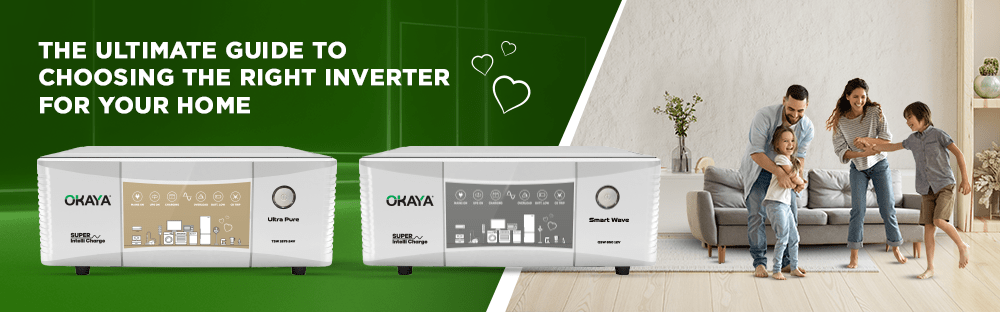
The right inverter for your home is chosen by load: what you run together, how long you need it to run and which Okaya range covers it. This guide sorts common home loads into the Home UPS and Hi-Capacity UPS ranges and shows what to check before you buy. Learn more about Okaya and its range.
An inverter converts DC power from a battery into AC power for your appliances during a cut. Before choosing one, check three things: the total load you will run together, the battery bank that matches the inverter and the output type, since electronics suit a sine wave output.
Okaya's Home UPS range, from 700 VA to 2000 VA, suits homes, apartments and small shops. Okaya's page states that the 700 VA and 925 VA models suit lights, fans and small appliances, and that a refrigerator typically needs at least 1150 VA. Compare the models in the Okaya Home UPS range.
|
VA rating |
Usable watts |
Battery system |
|
700 VA |
560 W |
12V |
|
925 VA |
740 W |
12V |
|
1150 VA |
920 W |
12V |
|
1450 VA |
1160 W |
12V |
|
1650 VA |
1320 W |
24V |
|
2000 VA |
1440 W |
24V |
If you are looking for a 1 kVA inverter, the nearest Home UPS is the 1150 VA model, which lists 920 W of usable output. Check the 1 kVA inverter price on the e-shop, and note that an inverter 1100VA search should be compared by usable watts, since VA and watts are not the same. Use the Okaya load calculator to size your load.
For loads above the Home UPS range, such as a shop, a small office or a large home, Okaya's Hi-Capacity UPS range lists four models: 2500 VA (2000 W) and 3200 VA (2560 W) on 24V, and 4000 VA (3200 W) and 6100 VA (4880 W) on 48V, with an LCD display. If you are looking for a heavy inverter, compare them in the Hi-Capacity UPS range. Air conditioners and water pumps need an inverter specifically rated and sized for that load, with a matching battery bank; confirm with a dealer or Okaya customer care. For medical or other critical equipment, confirm suitability with the equipment maker and Okaya customer care before relying on any inverter.
A pure sine wave inverter gives an output that follows the smooth wave shape of mains supply, which suits laptops, televisions, routers and appliances with motors. Okaya names the output of its Home UPS range Advanced True Sine Wave. Some inverters use a square wave or modified sine wave output, so read the specification sheet of the exact model. For more, read how to choose a sine wave inverter for your home.
A. Super Intelli Charge, listed as charging batteries 15% faster initially, using a Boost to Float mode.
B. EI Core, listed as reducing watt loss by about 20–25%.
C. Protections for overload, low battery, high battery, short circuit and over temperature, plus Auto Reset for mains short-circuit or fuse-trip conditions, resuming within 30 to 40 seconds.
D. LED indicators and alarms for low battery, overload and short-circuit or faults.
These are listed on the Okaya Home UPS range and manage abnormal operating conditions. They do not replace correct sizing or installation. Features can vary by model.
The right battery for a home is the one that matches the inverter voltage and gives the backup time you need at your load. A 12V Home UPS model generally uses one 12V battery, while a 24V model generally uses two identical 12V batteries in series. Confirm the recommended battery type, capacity and exact configuration for your model in the product manual or with an authorised dealer. Okaya lists Okaya inverter batteries in capacities from 90Ah to 310Ah. At the same load and under comparable conditions, a higher-capacity battery generally provides longer backup. Size the battery from both the load you plan to run and the backup time you need. Wiring and terminal connections should be done by a qualified electrician or technician.
Use the Dealer Locator on okaya.in to look for an authorised dealer if you are searching for an inverter near me. Ask which model covers your load in usable watts, which battery it needs and what the warranty card covers. Okaya lists a 36-month warranty on its Home UPS models. For service queries, call the Okaya customer care number, +91 9818 909090, or email care@okaya.in.
For more on sizing, read how to choose a UPS inverter for your home and the VA and usable watts guide.
What should I check first when choosing a home inverter?
Your total load in watts, the usable watts of the model, the battery configuration and the output type.
Which Okaya inverter suits a refrigerator?
Okaya's page states that a refrigerator typically needs at least 1150 VA. Check the starting demand on the refrigerator's label and the usable watts of the model.
Can an Okaya inverter run an air conditioner?
Only an inverter specifically rated and sized for that load, with a matching battery bank. Confirm with a dealer or Okaya customer care first.
Which Okaya inverter is for a shop?
For loads above the Home UPS range, Okaya lists its Hi-Capacity UPS range from 2500 VA to 6100 VA. Check usable watts against your load.
Is VA the same as watts?
No. Compare usable watts, such as 920 W for the 1150 VA Home UPS.
Can I install the inverter myself?
Wiring and terminal connections should be done by a qualified electrician or technician, following the product manual.
Where can I check Okaya inverter and battery prices?
Prices change by model and offer, so this guide does not list them. Check the current figures on the Okaya e-shop or ask an authorised dealer.
A. Inverter: compare models and the inverter 1100VA price on the e-shop, along with the 1 kVA listing above.
B. Battery: check the Okaya battery price for the capacity you need.
 OKAYA POWER PVT. LTD.
ENERGIS D-7, 3rd & 4th Floor, Rohtak Rd,
Udyog Nagar, Mangolpuri,
New Delhi - 110041, INDIA
© 2026 All Rights Reserved to Okaya Power Private Limited