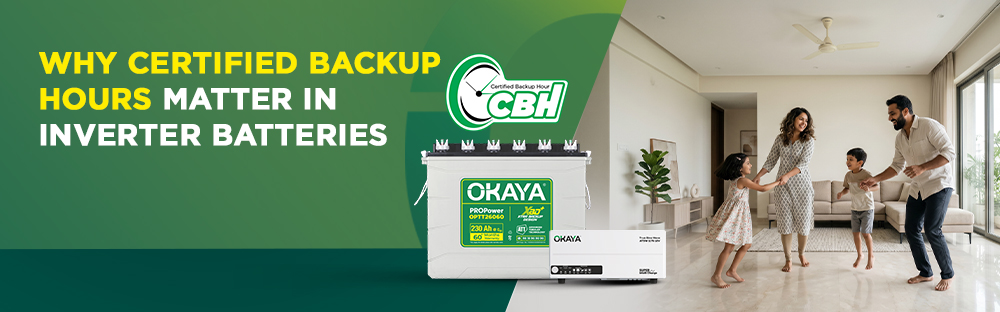
When you ask how long an inverter battery will last during a power cut, the answer in most cases is usually an estimate based on Ah rating and general assumptions. But actual backup performance depends on several operating and engineering factors beyond just stored capacity.
Okaya introduced CBH — Certified Backup Hours — to bring more transparency to inverter battery backup. Instead of relying only on estimated backup assumptions, users can now view tested runtime values under defined load conditions, verified through NABL-accredited third-party laboratory testing and printed directly on the battery packaging before purchase.
Most inverter batteries are compared primarily on Ah (Ampere Hour) rating. While Ah indicates how much energy a battery can store, it does not fully explain how long appliances will actually run during a power cut.
A measure of how much energy a battery can store. It reflects stored capacity — not actual runtime under real operating conditions.
Actual backup performance also depends on several additional factors such as battery plate design, internal construction quality, discharge efficiency, charging condition, and appliance load during usage. Because of these factors, two batteries with similar Ah ratings may still deliver different runtime performance during actual operation.
This is where Certified Backup Hours becomes important.
The actual runtime of an Okaya inverter battery tested under specific and controlled load conditions, verified through NABL-accredited third-party laboratory testing, and printed clearly on the battery packaging.
Unlike general backup assumptions, CBH values are scientifically measured under controlled charging and discharge conditions to help users understand expected runtime more transparently before purchase.
Each Certified Backup Hour value is:
1. Tested under defined load conditions
2. Verified through NABL-accredited third-party laboratories
3. Measured using controlled testing parameters
4. Printed clearly on the battery packaging for comparison
5. This gives homeowners a more reliable reference point while selecting an inverter battery for home backup requirements.
India’s government-recognized accreditation body for testing and calibration laboratories. NABL accreditation helps ensure that backup values are independently verified through standardized testing procedures.
Okaya introduced CBH Technology to bring measurable backup transparency to the inverter battery category.
Instead of depending only on estimated backup discussions, homeowners can now view tested backup values measured under controlled conditions and printed directly on the packaging for easier comparison before purchase.
This makes Okaya the first inverter battery brand in India to declare Certified Backup Hours on packaging through verified and standardized testing procedures.
Ab Backup Guess Nahi. Verify Karo.
How CBH Testing Works Under Defined Conditions
CBH values are tested under standardized operating conditions designed to create measurable and comparable runtime values across battery models.
UMHD — Urban Metro Heavy Duty
Okaya’s standardized test protocol based on typical Indian household load conditions. CBH values are validated under UMHD testing conditions.
Standard Test Parameters
|
Parameter |
Value |
|
Charging Method |
Constant current till TOC ≥15.5V |
|
Open Circuit Voltage (OCV) |
12.50–12.70V |
|
Specific Gravity |
1.25–1.26 |
|
Temperature |
27±2°C |
|
Cut-off Voltage at Discharge |
10.5V |
These controlled parameters help maintain consistency in runtime testing and allow customers to compare backup values more transparently across different battery models.
|
Factor |
Standard Inverter Battery |
Okaya CBH Battery |
|
Backup Information |
Ah rating only |
Certified Backup Hours at defined loads |
|
Basis of Backup Value |
General estimate |
NABL-tested and third-party verified |
|
Packaging Information |
Ah and warranty |
Ah, warranty, and CBH values |
|
Load Conditions Mentioned |
Usually not specified |
Tested under UMHD conditions |
|
Comparison Before Purchase |
Based on assumptions |
Based on verified runtime data |
|
Transparency |
Limited |
Verified backup information on packaging |
Backup hours are not fixed numbers. Runtime changes depending on the connected load during a power cut.
For example, a battery operating at 300W load conditions will naturally provide longer backup compared to the same battery operating at 600W load conditions.
This is why Okaya CBH values are measured against specific watt conditions such as 100W, 200W, 300W, and 400W. It helps homeowners understand expected backup performance more realistically based on actual usage patterns.
Instead of depending only on capacity numbers, users can compare tested runtime values under standardized operating conditions.
Okaya CBH batteries are integrated with XBD+ Technology (Xtra Backup Design Plus), designed to support longer and more dependable backup performance.
The batteries are engineered using advanced active material composition and optimized internal battery engineering to help improve discharge efficiency, charging response, and runtime delivery during power cuts.
Okaya offers XBD+ with CBH across:
A. Super Jumbo Tubular (SJT) series
B. Tall Tubular (TT) series
covering compact household backup requirements as well as higher-capacity applications for larger homes and heavier power loads.
Important Backup Considerations
Certified Backup Hours provide a verified reference point under controlled testing conditions. However, actual runtime in real-world usage can still vary depending on several practical factors including:
1. Appliance load during operation
2. Ambient temperature
3. Battery age
4. Charging conditions
5. State of Charge (SOC)
6. Usage patterns
Charging through an inverter may not always result in 100% State of Charge, and backup performance on a new battery may stabilize further after multiple charge-discharge cycles.
CBH helps homeowners compare tested backup values more transparently, while real-world runtime depends on actual operating conditions inside the home.
Okaya WhatsApp Chatbot helps homeowners explore inverter batteries, Home UPS systems, and solar solutions through a guided support experience directly on WhatsApp. Simply send “Hi” to +91 9818909090 to begin the journey, where users can explore product categories, compare solutions, access important product information, and connect for enquiries more conveniently.
The same chatbot also helps locate nearby authorized Okaya dealers by allowing users to enter their PIN code, after which nearby dealer details are shared instantly for faster product enquiries and purchase support. The platform additionally supports paperless warranty registration and guided after-sales assistance, creating a more connected and simplified journey from product discovery to dealer support and service assistance — all through a single WhatsApp-based platform.
What is CBH in an inverter battery?
CBH stands for Certified Backup Hours. It represents the tested runtime of an Okaya inverter battery under defined load conditions verified through NABL-accredited third-party laboratory testing and printed on the battery packaging.
How is CBH different from Ah rating?
Ah (Ampere Hour) indicates stored battery capacity. CBH helps users understand expected runtime at specific load conditions under standardized testing procedures.
What load conditions are used to test Okaya CBH values?
Okaya CBH batteries are tested under UMHD conditions using controlled parameters including temperature, voltage, specific gravity, and defined watt loads.
Are CBH values printed on Okaya battery packaging?
Yes. Certified Backup Hours are printed directly on the battery packaging to help homeowners compare tested runtime values before purchase.
Will actual battery backup always match the CBH value?
CBH values are verified runtime references measured under controlled testing conditions. Actual runtime can vary depending on appliance load, temperature, charging condition, battery age, and usage pattern.
Which Okaya batteries come with CBH Technology?
Okaya XBD+ inverter batteries across SJT and TT series are available with Certified Backup Hours.
How can homeowners explore Okaya CBH batteries before purchase?
Homeowners can explore Okaya inverter batteries through okaya.in or by sending “Hi” to +91 9818909090 on WhatsApp to compare products, locate dealers, and access support assistance.
Ah rating tells you how much energy a battery can store. Certified Backup Hours helps explain how long that energy is expected to support your home under defined operating conditions.
By combining controlled testing, NABL-accredited verification, and packaging-based transparency, Okaya CBH Technology helps homeowners compare inverter battery backup more confidently before purchase.
For users looking for a more informed and transparent approach to power backup selection, Certified Backup Hours provides a clearer way to evaluate inverter battery performance beyond just Ah capacity.
 OKAYA POWER PVT. LTD.
ENERGIS D-7, 3rd & 4th Floor, Rohtak Rd,
Udyog Nagar, Mangolpuri,
New Delhi - 110041, INDIA
© 2026 All Rights Reserved to Okaya Power Private Limited