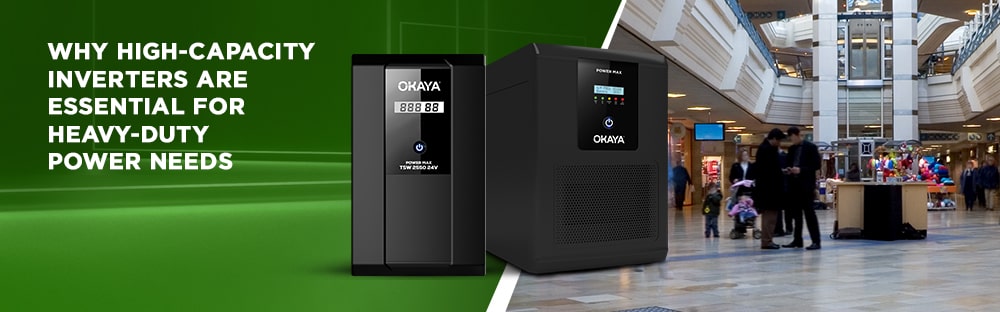
A standard Home UPS is designed for lighter household loads such as lights, fans and TVs. When the combined running load or startup surge of appliances exceeds its rating, a higher-capacity inverter/UPS is required. A heavy duty inverter is built for higher wattage and larger battery systems. This guide explains why heavy loads need a high capacity inverter, how to size one, and which Okaya Hi-Capacity UPS models are available.
A heavy-duty load is one where the total wattage, or the startup surge of motors and compressors, is more than a standard Home UPS can carry. Common examples include:
1. Air conditioners, water pumps and other motor-driven equipment whose startup surge is higher than their running load.
2. Shops, clinics and small offices running lights, computers, printers, CCTV and billing equipment together.
3. Large homes where many appliances run at the same time during a power cut.
Okaya's Home UPS range goes up to 2000 VA. Loads beyond that point are where the Hi-Capacity UPS range, from 2500 VA to 6100 VA, comes in.
Four reasons come up most often:
1. Total load: the inverter's watt rating has to be higher than everything you run together. Overloading a smaller unit can make it shut down.
2. Startup surge: motors and compressors draw more current when they start than when they run, so the inverter needs headroom beyond the running load.
3. Battery system voltage: higher-capacity inverters use 24V or 48V battery systems. For the same power, a higher system voltage means lower current, which is easier on cables and connections.
4. Output quality: motors, computers and other sensitive electronics generally operate more smoothly on sine-wave output than on square-wave output.
Okaya's Hi-Capacity UPS range is the POWER MAX series, built on Advanced True Sine Wave (ATSW) technology. Features listed on Okaya's product pages include:
1. Advanced True Sine Wave output, for smooth, grid-like power.
2. Peak current handling for motorised loads. Okaya states the range can support over 100% load without interrupting operations; suitability still depends on the inverter and battery capacity.
3. Super Intelli Charge, which Okaya states charges batteries 15% faster according to the inverter charging profile.
4. EI Core design, for lower power loss and less heat generation.
5. Protections: overload, low-battery, high-battery, input and output short-circuit, over-temperature, and fuse/MCB trip protection. The 6100 VA model additionally includes Active Battery Reverse Protection, which Okaya lists as exclusive to that model.
6. Audio and display indication, so the unit's status is visible at a glance.
All models are BIS Registered, ISO Certified and carry CE Mark.
Which Okaya Hi-Capacity UPS models are available?
|
Capacity |
Power |
System voltage |
12V batteries needed |
Warranty |
|
2500 VA |
2000 W |
24V |
2 |
36 months |
|
3200 VA |
2560 W |
24V |
2 |
36 months |
|
4000 VA |
3200 W |
48V |
4 |
36 months |
|
6100 VA |
4880 W |
48V |
4 |
36 months |
For a model-by-model comparison, see the Hi-Capacity UPS models list.
Add the running wattage of everything you want to use together. Then add allowance for the startup surge of motors and compressors, and choose a model whose watt rating is higher than the total.
If you are working from VA, divide the wattage by the power factor. A power factor of around 0.8 is commonly used as a working estimate for simple sizing, although the actual value varies by appliance and load.
Okaya's load calculator can help you total your appliances. For air conditioners in particular, read whether an AC can run on an inverter before choosing a model, since the AC's running wattage and startup surge decide the size.
A 24V model uses two 12V inverter batteries and a 48V model uses four. Backup time depends on the battery capacity and the load you connect: a larger battery or a lighter load gives longer backup. Okaya publishes Certified Backup Hours for its inverter batteries, so you can compare them against your combined load. Ask a dealer for the right battery capacity for your model and expected backup time.
Typical uses are large homes with air conditioning, shops, offices and clinics. A high power inverter setup for a shop or office usually runs lights, computers, a printer and CCTV together, and the right model is the one whose watt rating covers the combined load. For a detailed view of home and office use, read high-capacity UPS power solutions for large homes and offices.
All four models carry a 36-month warranty. For model advice or installation help, call Okaya Care on +91 9818 909090, write to care@okaya.in, or find a nearby outlet through the dealer locator.
Why do heavy-duty loads need a high-capacity inverter?
Heavy loads add up to more wattage than a standard Home UPS can carry, and motors and compressors draw extra current at startup. A high-capacity inverter has the watt rating and battery system to handle both.
What is the difference between a Home UPS and a Hi-Capacity UPS?
Okaya's Home UPS range goes up to 2000 VA, while the Hi-Capacity UPS range goes from 2500 VA to 6100 VA for heavier loads.
How do I choose the right high-capacity inverter?
Add the running watts of the appliances you want to run together, allow for motor startup, and choose a model whose watt rating is higher than the total.
Can a high-capacity inverter run an air conditioner?
It can, if the air conditioner and any other connected loads are within the model's rating and the battery capacity. A standard Home UPS is generally not recommended for air conditioners, so check the AC's running wattage and startup surge before choosing.
How many batteries does a high-capacity inverter need?
A 24V model uses two 12V batteries and a 48V model uses four.
Does a high-capacity inverter give pure sine wave output?
Okaya's POWER MAX range uses Advanced True Sine Wave technology, which delivers smooth, grid-like output.
What protections does the POWER MAX range have?
Overload, low-battery, high-battery, input and output short-circuit, over-temperature and fuse/MCB trip protection. The 6100 VA model additionally includes Active Battery Reverse Protection.
What is the warranty on an Okaya Hi-Capacity UPS?
36 months on all four current models.
To see current options, check the 2kw inverter price for the 2500 VA model or the 4 kva inverter price for the 4000 VA model on the Okaya shop.
 OKAYA POWER PVT. LTD.
ENERGIS D-7, 3rd & 4th Floor, Rohtak Rd,
Udyog Nagar, Mangolpuri,
New Delhi - 110041, INDIA
© 2026 All Rights Reserved to Okaya Power Private Limited