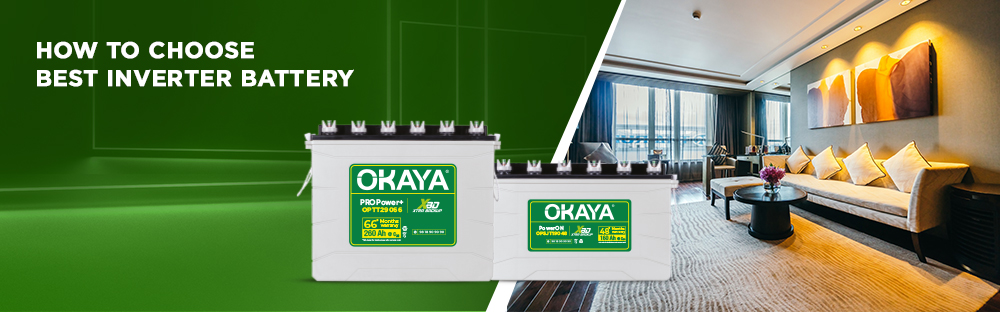
The best inverter battery for your home is the one whose capacity matches your load, whose backup hours are certified rather than claimed, and whose voltage and size fit your inverter. Warranty and after-sales support decide how well it holds up over the years. This guide walks through each check in order, so you can compare any best inverter battery shortlist against your own power needs, and shows how Okaya's range and Certified Backup Hours (CBH) fit into the decision.
What should you check before choosing an inverter battery?
Check five things in this order: your total load in watts, the backup hours you need, the battery technology, the certified backup and warranty, and whether the battery matches your inverter's voltage and your available space.
1. Load and backup hours: decide which appliances must run during a power cut and for how long.
2. Capacity (Ah): choose a rating that delivers those hours after real-world losses.
3. Technology: tubular plates are designed for the repeated charge and discharge a home inverter puts a battery through.
4. Certified backup and warranty: compare tested backup hours and the months of coverage, not just the Ah label.
5. Fit: confirm the system voltage (12V or 24V) and that the battery fits your trolley or stand.
Ah (ampere-hour) is the battery's rated charge capacity, watt is the power an appliance draws, and VA is the inverter's apparent power rating. A higher Ah rating lets the battery supply the same load for longer.
Ah: how much charge the battery stores. Multiply Ah by the battery voltage to get stored energy in watt-hours (Wh).
Watt (W): the power an appliance uses, printed on its label. A 100 W bulb draws 100 watts.
VA: the inverter's capacity. It limits how much load you can connect, while the battery decides how long that load runs.
Add up the watts of the appliances you want to run, multiply by the backup hours you need to get watt-hours, and divide by the battery voltage to get the Ah. The result is a minimum, because real backup is always lower than the calculation.
Step 1: List the appliances and their watts, for example 2 fans at 80 W (160 W) and 3 LED bulbs at 10 W (30 W), a total load of 190 W.
Step 2: Theoretical backup (hours) = battery capacity (Ah) x battery voltage (V) / total load (W).
Step 3: For a 12V, 160Ah battery, that is 1920 Wh / 190 W, about 10.1 hours on paper.
For this 190 W example, the closest published CBH test load is 200 W. Okaya's 160Ah Tall Tubular 60-month model is certified at 8 hours 45 minutes at 200 W. The real-world figure is lower than the ideal theoretical estimate because of inverter losses, usable battery capacity and the slightly higher test load. Use an inverter battery load calculator to total your load, and see how much Ah an inverter battery is required for a home for a step-by-step worked example.
Okaya suggests 90Ah for compact needs, 160Ah for a 2BHK home, 210Ah for larger homes or longer backup, 260Ah for heavy loads and 310Ah for commercial use. Compare these against your own load and the ratings listed under home inverter battery capacity.
|
Home scenario |
Example load |
Okaya's suggested capacity |
|
Compact (1-2 rooms) |
3 LED bulbs (30 W), 1 fan (80 W), router (15 W), TV (50 W) = 175 W |
90Ah |
|
2BHK |
A few fans and lights, TV and router, plus a refrigerator |
160Ah |
|
Larger home or longer backup |
More fans and lights, TV, refrigerator, work-from-home equipment |
210Ah |
|
Heavy loads |
A higher number of running appliances at the same time |
260Ah |
|
Commercial or heavy-duty use |
Shops and small offices with a continuous load |
310Ah |
For the largest capacity, the highest capacity inverter battery in the range is the 310Ah model, declared by Okaya at 600 W, 500 W, 400 W and 300 W. If you plan to run air conditioners or other heavy loads, a single 12V battery is not the right setup. Look at high-capacity inverter systems that use several batteries.
Look for a tubular battery. Tubular plates are built for the deep, repeated discharge cycles that home inverters create, and Okaya's current inverter battery range is built on Advanced Tubular Technology (ATT) and includes JXT, Super Jumbo Tubular (SJT) and Tall Tubular (TT) formats, depending on the capacity.
JXT, SJT and TT: these are the container formats (JXT, Super Jumbo Tubular and Tall Tubular), used depending on the capacity. Tall tubular batteries are taller and narrower, so check the space on your stand or trolley.
XBD+ (Xtra Backup Design Plus): Okaya states that XBD+ technology gives up to 15-20% longer backup than conventional tubular batteries of the same Ah rating.
AEMS: the crown cover has six ceramic water level indicators, so you can check levels and top up with distilled water without tools or spills.
Low-antimony alloy: designed to reduce water loss and the need for frequent topping up.
Okaya also states that its Super Jumbo Tubular (SJT) models recharge about 15% faster than conventional Jumbo Tubular batteries. These are manufacturer claims, so use the certified backup hours below as the common yardstick when you compare batteries.
Certified Backup Hours (CBH) are tested backup durations at fixed loads, printed on the battery packaging. Okaya tests under the UMHD (Urban Metro Heavy Duty) load cycle in NABL-accredited third-party labs, so you can compare actual runtimes before you buy. The table below shows two shared test loads (400 W and 300 W) for every capacity; the full table is on the Certified Backup Hours (CBH) page.
|
Capacity (Ah) |
Series |
Warranty (months) |
CBH at 400 W |
CBH at 300 W |
|
90 |
PowerOn |
48 (24+24) |
1:15 |
1:45 |
|
110 |
PowerOn |
48 (24+24) |
1:45 |
2:45 |
|
140 |
PowerOn |
48 (24+24) |
2:30 |
3:50 |
|
160 (tall tubular) |
PROPower |
60 (36+24) |
3:15 |
5:05 |
|
190 |
PROPower |
60 (36+24) |
4:20 |
6:25 |
|
210 (tall tubular) |
PROPower |
60 (36+24) |
4:40 |
7:10 |
|
230 |
PROPower |
60 (36+24) |
5:30 |
8:00 |
|
260 |
PROPower+ |
66 (42+24) |
6:15 |
9:15 |
|
310 |
PROPower |
60 (36+24) |
6:40 |
9:45 |
Read the table against your own load. If your appliances add up to about 300 W, a 160Ah battery is certified at 5 hours 5 minutes, while a 210Ah battery is certified at 7 hours 10 minutes.
A longer warranty gives more months of coverage, so compare the total months and the flat plus pro-rata split. Okaya's range is covered for 48 to 66 months.
|
Series |
Warranty (months) |
Capacities |
|
PowerOn |
48 (24 flat + 24 pro-rata) |
90Ah, 110Ah, 140Ah, 160Ah (SJT), 210Ah (TT) |
|
PROPower |
54 (30+24) or 60 (36+24) |
160Ah, 190Ah, 210Ah, 230Ah, 310Ah |
|
PROPower+ |
66 (42+24) |
260Ah |
Source: Okaya CBH table and SKU range. Warranty is shown as total months (flat + pro-rata).
Okaya also lists digital warranty registration and PAN India onsite service on its battery pages. Register the battery as soon as it is installed, so the warranty period is on record.
Yes. The battery voltage must match the inverter's system voltage: a 12V inverter uses one 12V battery, and a 24V inverter uses two 12V batteries connected in series. Within that, you can choose the Ah to suit your backup hours. Check the inverter manual for the recommended capacity range and read why compatibility matters in power backup systems before you pair them.
Also check the inverter battery size (length, width and height) against your trolley or stand. Exact dimensions are listed on each product page.
Buy from an authorised source that registers the warranty in your name. If you prefer to see the battery in person, the Okaya dealer locator lists stores near you, which helps when you search for an inverter battery near me.
For heavy loads, the Okaya 260Ah battery price and specifications are listed on the Okaya shop along with its warranty details.
Keep the water level correct, use only distilled or demineralised water for topping up, and avoid running the battery flat repeatedly. How long the battery lasts depends on usage, maintenance, charging settings and ambient temperature, so these habits matter more than any single figure. The FAQ below gives Okaya's stated typical service life.
How do I choose the best inverter battery for my home?
Total the watts of the appliances you want to run, decide your backup hours, and pick a tubular battery whose certified backup hours cover that load. Then confirm the voltage matches your inverter and compare warranty months.
What is Ah in an inverter battery?
Ah means ampere-hour, the battery's rated charge capacity. Multiplying Ah by the battery voltage gives the stored energy in watt-hours, and a higher Ah rating gives longer backup at the same load.
Which type of inverter battery is best for home use?
Tubular batteries are designed for repeated deep-discharge and recharge cycles, which suits home inverters. Okaya's inverter batteries use Advanced Tubular Technology across JXT, Super Jumbo Tubular (SJT) and Tall Tubular (TT) formats, depending on the capacity.
Which Ah battery should I buy for my inverter?
It depends on your load and backup hours. Okaya suggests 90Ah for compact needs, 160Ah for a 2BHK home, 210Ah for larger homes or longer backup, 260Ah for heavy loads and 310Ah for commercial use.
Can I use a higher Ah battery with my inverter?
You can use a higher-Ah battery if the voltage matches and the battery capacity falls within the inverter's recommended range. A higher Ah can provide longer backup but may also take longer to recharge, so check the inverter manual or Okaya Care before upgrading.
How do I calculate inverter battery backup time?
Multiply the battery Ah by its voltage and divide by the total load in watts for a theoretical figure. Real backup is lower, so use Okaya's Certified Backup Hours at set loads to cross-check.
What should I check when buying a high-capacity battery of 250Ah or more?
Check that the battery voltage and the inverter's recommended range suit it, compare certified backup hours at your load, confirm the warranty months and that the battery fits your stand. Okaya's range goes up to 260Ah and 310Ah.
What is the difference between certified backup and claimed backup?
Certified backup hours are measured at stated loads under a defined test cycle by a third-party lab and printed on the pack. Claimed backup has no stated test load, so it cannot be compared reliably.
What warranty do Okaya inverter batteries have?
Okaya inverter batteries carry 48 to 66 months of total warranty depending on the model, shown as flat plus pro-rata months.
How long does an inverter battery last?
Okaya's inverter battery page states a typical service life of 4 to 6 years, and the actual life depends on usage, maintenance, charging settings and ambient temperature. Service life is different from the warranty, which is 48 to 66 months depending on the model.
Which Okaya battery gives the longest backup?
At the shared 400 W and 300 W test loads, the 310Ah model is certified at 6 hours 40 minutes and 9 hours 45 minutes, and the 260Ah model at 6 hours 15 minutes and 9 hours 15 minutes. Check the CBH table for your own load.
Compare ratings and the latest inverter battery price on the Okaya shop, or use the Okaya dealer locator to find a store near you.
 OKAYA POWER PVT. LTD.
ENERGIS D-7, 3rd & 4th Floor, Rohtak Rd,
Udyog Nagar, Mangolpuri,
New Delhi - 110041, INDIA
© 2026 All Rights Reserved to Okaya Power Private Limited