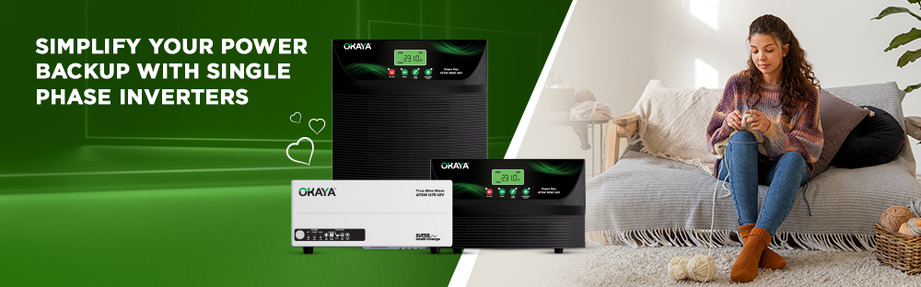
If your home has a single-phase electricity connection and you're installing rooftop solar, a single phase solar inverter can be a suitable option for converting the power your panels generate into electricity your home can use.
In rooftop solar, the term "single phase inverter" commonly refers to an on-grid or grid-tied solar inverter designed for homes with a single-phase electricity connection. While the term inverter is often associated with backup power, this guide focuses specifically on single phase on-grid solar inverters. Unlike a battery-based Home UPS, an on-grid solar inverter normally shuts down during a grid outage - a distinction that matters if backup power is what you're actually looking for.
A single-phase solar inverter converts the DC electricity produced by rooftop solar panels into AC electricity compatible with a standard single-phase home supply. It's also referred to as an on-grid inverter or grid-tied inverter, since - unlike an off-grid solar PCU - it is designed to operate in sync with the electricity grid whenever the grid supply is available, rather than operating independently of it.
This grid connection is what defines how the system behaves day to day: it allows solar generation and grid supply to work alongside each other, rather than requiring the home to run on one or the other in isolation.
The basic energy flow looks like this: solar panels generate DC electricity, the inverter converts it to AC, and that AC electricity is used by the home or exported to the grid.
Breaking that down further:
1. The inverter converts the DC output from the solar panels into AC electricity matched to your home's wiring.
2. It synchronises with the grid's voltage and frequency, which allows solar generation and grid supply to operate together rather than as separate, switching sources.
3.Available solar power is consumed by the home first.
4. Any additional requirement beyond what the panels are generating at that moment is supplied by the grid.
5. Eligible surplus solar generation may be exported to the grid, depending on the applicable net-metering arrangement with your DISCOM.
Anti-islanding - an important safety function: A standard on-grid solar inverter automatically shuts down when the grid fails. This is a mandatory safety requirement, not a malfunction — it prevents the system from feeding electricity back into grid lines that utility staff may be working on during an outage. As a result, a standard on-grid inverter alone does not provide power backup during a power cut. This is a different function from a battery-based Home UPS, which is designed specifically to supply backup power when grid electricity is unavailable. The two should not be treated as equivalent.
1. Designed for homes with a single-phase electricity connection
2. Converts solar DC output into usable AC electricity
3. Operates in sync with the electricity grid (grid-tied)
4. Commonly used in residential rooftop solar installations
5. Can support grid export and net metering, subject to DISCOM rules
6. Standard on-grid models do not provide power-cut backup on their own
Okaya's single phase on-grid inverter range is available in three capacities: 3kW, 3.4kW, and 5kW.
Key features across Okaya's single phase on-grid inverter range include:
1. A maximum conversion efficiency of up to 98%
2. A DC input overload capacity of 120%
3. MPPT (Maximum Power Point Tracking), with one MPPT tracker and one string input per model
4. An IP65 protection rating
5. BIS certification, along with compliance to IEC 62109-1/2, IEC 61727, IEC 61683, IEC 60068, IEC 62116, and IEC 61000 EMC standards
6. RS485, USB, and Wi-Fi connectivity for remote monitoring
7. Feed-in limitation support for compliance with utility regulations
8.A 10-year (120-month) standard warranty
For current prices, offers and model availability, check the respective 3kW, 3.4kW, and 5kW inverter pages on the Okaya website, or the 3kW solar inverter price, 3.4kW solar inverter price, and 5kW solar inverter price pages on the shop platform. Okaya's broader on-grid solar inverter range, covering both single phase and three phase models, is also available to browse.
Single Phase vs Three Phase Solar Inverter
Okaya offers both single phase and three phase on-grid inverters, including 5kW variants in each - these are distinct products built for different electrical connections, not the same model listed twice.
|
Parameter |
Single Phase On-Grid Inverter |
Three Phase On-Grid Inverter |
|
Capacity range |
3kW, 3.4kW, 5kW |
5kW, 8kW, 10kW, 15kW |
|
Typically suitable for |
Homes with a single-phase electricity connection |
Larger homes or commercial/industrial sites with a three-phase connection |
|
Electricity connection required |
Standard single-phase supply |
Three-phase supply, generally where the sanctioned load requires it |
|
MPPT / string configuration |
1 MPPT, 1 string across all models |
5kW: 1 MPPT, 1 string. 8kW & 10kW: 2 MPPT, 1 string each. 15kW: 2 MPPT, 2 strings each |
|
Maximum conversion efficiency |
Up to 98% |
Up to 98% |
|
DC input overload |
120% |
120% (permitted DC input voltage varies by model) |
|
Warranty |
10 years (120 months) |
10 years (120 months) |
Whether a single phase or three phase system is appropriate depends on the electricity connection already available at the property and the sanctioned load approved by the local DISCOM — this is generally confirmed at the time of system design rather than assumed in advance.
1. Potential reduction in grid electricity use: A rooftop solar system can reduce the amount of electricity drawn from the grid, which may help lower electricity bills depending on solar generation, consumption patterns, and applicable regulations.
2. Net metering: Where supported by the local DISCOM, surplus solar power exported to the grid may be adjusted against electricity consumption under the applicable net metering policy.
3. PM Surya Ghar Muft Bijli Yojana: Eligible residential rooftop solar installations may qualify for central government subsidy under this scheme. Our PM Surya Ghar subsidy guide explains the eligibility and savings in more detail.
4. Maintenance: With no moving parts and an IP65-rated enclosure, routine inverter maintenance requirements are generally limited, subject to installation and operating conditions.
A few factors are generally worth checking before finalising a capacity:
1. Available rooftop space: This determines how large a panel array can realistically be installed, which in turn should be matched to the inverter capacity.
2. Sanctioned electrical load: Your DISCOM-sanctioned load, along with net metering eligibility, can influence the maximum system size permitted.
3. Daily electricity consumption: Homes with higher daily consumption may benefit from a larger system, such as the 5kW option, to make fuller use of the solar power generated — subject to rooftop potential, sanctioned load, and overall system design.
4. Check your electricity connection type: Confirm whether the property has a single-phase or three-phase electricity connection, and check the applicable DISCOM requirements, before selecting the inverter.
5. Future system requirements: The supported DC oversizing ratio (120% on Okaya's single phase range) may provide some flexibility in array sizing, subject to the inverter's permitted DC voltage, current, and string limits - this is generally confirmed against the specific product's technical specifications rather than assumed.
For help understanding the broader category, see our guide on on-grid vs off-grid solar inverters/PCUs.
Frequently Asked Questions
What is a single phase solar inverter?
A single phase solar inverter is an on-grid or grid-tied inverter that converts DC power from solar panels into single-phase AC power, synchronised with the electricity grid, for homes with a standard single-phase connection.
What capacities does Okaya offer in single phase solar inverters?
Okaya's single phase on-grid range is available in 3kW, 3.4kW, and 5kW capacities.
How is a single phase solar inverter different from a three phase one?
A single phase inverter is designed for a standard single-phase electricity connection (Okaya's range: 3kW, 3.4kW, 5kW). A three phase inverter is designed for a three-phase connection, typically used in larger homes or commercial/industrial settings (Okaya's range: 5kW, 8kW, 10kW, 15kW).
Is a single phase inverter suitable for a 3kW solar system?
A 3kW rooftop solar system can commonly use a 3kW single phase inverter where the property has an appropriate single-phase connection, subject to system design and DISCOM requirements.
Does a single phase on-grid inverter work during a power cut?
No. A standard on-grid solar inverter shuts down automatically during a grid outage, as a mandatory anti-islanding safety requirement. It does not function as a power backup source on its own; a battery-based Home UPS is designed for that purpose instead.
Can a single phase solar inverter be used with a three-phase electricity connection?
This depends on the specific system design and applicable DISCOM requirements at the property. It should be confirmed with a qualified installer or the local utility rather than assumed, since electrical connection type and sanctioned load requirements can vary by case.
What efficiency does Okaya's single phase solar inverter range offer?
Up to 98% maximum conversion efficiency, based on available product specifications.
Can more solar panels be added later with a single phase inverter?
Okaya's single phase inverters support a 120% DC input overload, which may allow some flexibility for future array expansion - subject to the inverter's permitted DC voltage, current, and string limits for the specific model.
Does a single phase on-grid inverter support net metering?
The inverter can support grid export, while actual net-metering availability and eligibility depend on the applicable DISCOM policy.
Does Okaya's single phase solar inverter have Dual MPPT?
No. Okaya's single phase range (3kW, 3.4kW, 5kW) uses a single MPPT tracker with one string input. Dual MPPT is available on select models in Okaya's three phase range instead.
What does Okaya's single phase on-grid solar inverter cost?
Pricing varies with ongoing offers and market conditions. Current pricing for each capacity is available on the respective product pages.
A single phase solar inverter is generally suited to homes with a single-phase electricity connection installing rooftop solar. Okaya's single phase range covers 3kW, 3.4kW, and 5kW capacities, with the right choice depending on factors such as the sanctioned electrical load, daily electricity consumption, available rooftop space, overall system design, and applicable DISCOM requirements. Confirming these details before installation helps ensure the system selected matches the property's actual electrical setup and solar generation needs.
 OKAYA POWER PVT. LTD.
ENERGIS D-7, 3rd & 4th Floor, Rohtak Rd,
Udyog Nagar, Mangolpuri,
New Delhi - 110041, INDIA
© 2026 All Rights Reserved to Okaya Power Private Limited