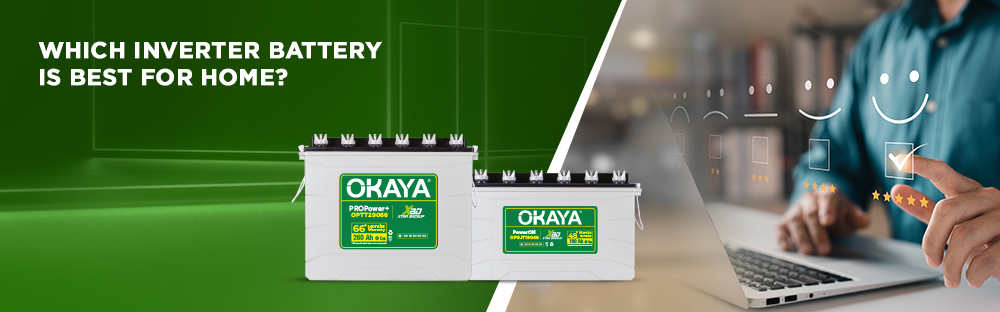
If you're comparing inverter batteries for your home, the honest answer is: it depends on your home's size, your daily power backup needs, and how much you trust the backup claim on the box. This guide walks through what actually makes one inverter battery a better fit than another - capacity, technology, and a transparency standard called Certified Backup Hours — so you can choose based on real numbers, not guesswork.
Most people start by comparing Ah (Ampere Hour) ratings, assuming a higher number always means better backup. Ah (Ampere Hour) indicates an inverter battery's charge capacity. It is an important factor in backup, but it doesn't by itself tell you exactly how long your fans, lights, and Wi-Fi router will run during a power cut. Two batteries with the same Ah rating can still deliver noticeably different runtime, depending on plate design, internal construction, and charging efficiency.
That's why choosing the right battery usually comes down to a few things:
1. Capacity suited to your home's size and load - a compact flat needs less than a large villa or a shop running heavier equipment.
2. Verified backup performance, not just an estimated Ah number.
3. Warranty and build quality that match how long you expect to keep the battery.
4. The brand's manufacturing and service backing - an inverter battery is a long-term purchase, so it's worth checking whether the brand manufactures in-house, has an established service network, and backs its backup claims with independent testing rather than just marketing copy.
Rather than comparing model numbers, the right home inverter battery capacity is best chosen based on your space and typical load:
Compact homes and everyday backup - for lighter loads (fans, lights, a router, a TV), a battery in the 90–140Ah range is generally sufficient for smaller flats or homes with modest backup needs.
Standard homes, 2BHK and similar - the 160Ah range is a common starting point for 2BHK homes, offering a balance of backup duration and space efficiency.
Larger homes and higher daily load - homes with more appliances running during outages, or slightly larger BHK configurations, typically move toward the 190–210Ah range.
Heavy backup needs - large homes, offices, shops, commercial setups — for extended outages or heavier equipment, the 230Ah and above range (up to 310Ah) is built for longer, heavier-duty backup.
For a more detailed breakdown by BHK size, see our dedicated guide: Top Power Backup Solutions for 1BHK, 2BHK, and 3BHK Homes.
Why Ah Rating Alone Doesn't Tell You the Full Story
This is the part most buying guides skip - and it's the difference that actually matters once you've narrowed down a capacity.
Okaya introduced Certified Backup Hours (CBH) to address exactly this gap. Instead of relying only on an estimated Ah-based assumption, Okaya's inverter batteries are tested under defined load conditions — 100W, 200W, 300W, and 400W (300W–600W for the highest-capacity model) — verified through NABL-accredited third-party laboratory testing, and the resulting runtime is printed directly on the battery packaging before you buy.
Testing follows Okaya's standardized UMHD (Urban Metro Heavy Duty) protocol, based on typical Indian household load conditions, under controlled parameters (constant current charging till TOC ≥15.5V, OCV 12.50–12.70V, specific gravity 1.25–1.26, temperature 27±2°C, cut-off voltage 10.5V).
Okaya states that it is India's first inverter battery brand to declare Certified Backup Hours on packaging through standardized, third-party-verified testing - so instead of comparing Ah numbers and hoping, you can compare actual tested runtime before you buy. (Read the full explainer: Why Certified Backup Hours Matter in Inverter Batteries)
The Technology Behind Longer Backup: XBD+
Okaya's inverter batteries across the Super Jumbo Tubular and Tall Tubular range are built with XBD+ (Xtra Backup Design Plus) — an advanced active material composition combined with optimized internal battery engineering, designed to deliver up to 15–20% longer backup compared to a standard inverter battery at the same Ah rating, along with faster recharge after a power cut.
Okaya's Super Jumbo Tubular (SJT) models feature a 6×1 water-inlet layout, placing all water inlets on one side for safer, more convenient top-up. Tall Tubular (TT) models use a different electrolyte-management design - a vent-plug and float mechanism built for spill-free water topping — alongside 6 ceramic water-level indicators for easier monitoring. Both series are built for low maintenance - typically needing only 1–2 water top-ups a year. (See how it works in detail: How Okaya XBD+ Delivers Longer Backup for Modern Homes)
Inverter Battery Capacity at a Glance
|
Suited For |
Capacity Range |
|
Compact homes, light everyday load |
90Ah – 140Ah |
|
Standard homes (2BHK and similar) |
160Ah |
|
Larger homes, higher daily load |
190Ah – 210Ah |
|
Heavy backup — large homes, offices, shops, commercial |
230Ah – 310Ah |
Backup hours vary by exact capacity, not just by range, so here's the tested figure for each individual model rather than a grouped estimate. For instance, 160 Ah battery backup time sits in the 2 hours 55 min to 3 hours 15 min band at 400W, depending on the exact variant.
|
Capacity |
Backup at 400W Load* |
|
90Ah |
~1 hour 15 min |
|
110Ah |
~1 hour 45 min |
|
140Ah |
~2 hours 30 min |
|
160Ah |
~2 hours 55 min to 3 hours 15 min** |
|
190Ah |
~4 hours 20 min |
|
210Ah |
~4 hours 30 min to 4 hours 40 min** |
|
230Ah |
~5 hours 30 min |
|
260Ah |
~6 hours 15 min |
|
310Ah |
~6 hours 40 min |
*Certified Backup Hours, tested under UMHD conditions. Actual backup can vary with ambient temperature, battery age, inverter used, and State of Charge.
**160Ah and 210Ah are each available in multiple warranty-tier variants with slightly different tested backup — the range reflects that variation within the same capacity, not a range across different capacities.
Warranty varies by exact model, ranging from 48 months to 66 months, with flat and pro-rata periods depending on the variant.
Okaya's 160Ah range, including 60-month warranty variants, offers a balance of backup duration and space efficiency for standard homes. You can check the okaya battery 160ah price on the shop platform for current availability.
If you're looking for a big inverter battery, Okaya's 310Ah model is currently the largest single-unit option available, built for heavy backup needs where a home or setup requires extended runtime beyond the mid-capacity range. For homes with higher daily backup requirements, the 190Ah Tall Tubular battery offers dependable performance and longer runtime, backed by the same XBD+ engineering and CBH-tested backup transparency across Okaya's range.
The 260Ah Tall Tubular (TT) battery is built for reliable backup and long-term performance, ensuring consistent energy delivery for homes, offices, and small commercial setups. If you're comparing the 250ah battery price, you can explore this and Okaya's other inverter battery capacities on the shop platform.
For a 24V inverter, two matched 12V batteries are connected in series rather than used as a single unit — this is sometimes searched as a "double battery" setup. The battery bank remains at the same Ah rating as each individual battery, while total nominal energy capacity increases because the system voltage doubles. Actual backup still depends on load, inverter efficiency, and battery condition.
For a full inverter battery price list across every capacity, Okaya's shop platform lists current pricing and availability for each model, alongside the complete inverter battery specifications on the main website.
Why Manufacturing and Service Backing Matter
Beyond capacity and backup numbers, it's worth knowing who is behind the battery. Okaya Battery is backed by over two decades of experience in power backup and energy storage, with in-house manufacturing and dedicated R&D rather than outsourced production. This matters particularly for homes dealing with frequent or extended power cuts, where consistent build quality and a reliable, pan-India service network make a real difference over the battery's warranty period — not just at the point of purchase.
For entry-level budgets, the 90–140Ah range is typically the most economical starting point, while still carrying the same CBH-tested backup transparency as the higher-capacity models.
The 230Ah Tall Tubular (TT) battery similarly delivers dependable backup and long-term performance for homes and small commercial setups with higher daily power needs. If you're comparing 220Ah inverter batteries, you can explore this and Okaya's other inverter battery capacities on the shop platform.
Conclusion
The best inverter battery for your home isn't necessarily the one with the highest Ah number — it's the one whose tested backup performance actually matches your household's size and load. Start by matching capacity to your home type, then compare verified runtime data like Certified Backup Hours rather than relying on estimates alone. Warranty terms and maintenance requirements are worth checking too, since they affect the total cost of ownership over the battery's life.
Which inverter battery is best for a home?
The right choice depends on your home's size and daily backup needs rather than a single "best" model. Smaller homes are typically well served by the 90–140Ah range. For many 2BHK homes, 160Ah can be a practical starting point, but the right capacity depends on the appliances to be backed up and the required backup duration. Larger homes or heavier loads typically move toward 190Ah and above.
Is a higher Ah rating always better?
Not necessarily. Ah reflects the battery's charge capacity, not its actual runtime. Two batteries with the same Ah rating can deliver different backup depending on internal design and construction — which is why checking tested backup data (like Certified Backup Hours) alongside Ah rating gives a more complete picture.
What is Certified Backup Hours (CBH)?
CBH is the actual tested runtime of an Okaya inverter battery under defined load conditions. Most models are tested at 100W, 200W, 300W and 400W, while the highest-capacity 310Ah model is tested at higher loads from 300W to 600W — verified by NABL-accredited third-party laboratories and printed on the battery packaging, so backup performance can be compared before purchase rather than estimated.
What capacity is suitable for a 2BHK home?
The 160Ah range is a commonly suitable starting point for 2BHK homes, though the ideal size can vary based on the specific appliances you want to back up.
How long does an inverter battery typically last?
Lifespan depends on usage patterns and maintenance, but tubular batteries with proper care (regular water top-up, avoiding deep discharge) are designed for long-term, consistent performance across their warranty period.
What warranty do Okaya inverter batteries come with?
Warranty varies by model, ranging from 48 months to 66 months, structured as a flat warranty period followed by a pro-rata period (for example, 24 months flat + 24 months pro-rata).
What does XBD+ technology do?
XBD+ (Xtra Backup Design Plus) uses advanced active material composition and optimized internal engineering to deliver up to 15–20% longer backup than a standard inverter battery at the same Ah rating, along with faster recharge.
What is the highest-capacity inverter battery Okaya offers for home use?
310Ah is currently Okaya's largest single-unit inverter battery capacity, designed for heavy backup needs in larger homes, offices, or commercial setups. For even higher requirements, batteries can also be paired in multiples as part of a combo setup.
What is a "double battery" inverter setup?
It refers to connecting two matched 12V batteries in series to run a 24V inverter, typically needed for higher-VA inverters. The Ah rating stays the same as a single battery, while total nominal energy capacity increases because the system voltage doubles; actual backup still depends on load, inverter efficiency, and battery condition.
Where can I find an inverter battery price list for different capacities?
Current prices across all capacities are listed on Okaya's shop platform, updated with ongoing offers and market conditions, so it's best checked there rather than relying on a fixed figure.
 OKAYA POWER PVT. LTD.
ENERGIS D-7, 3rd & 4th Floor, Rohtak Rd,
Udyog Nagar, Mangolpuri,
New Delhi - 110041, INDIA
© 2026 All Rights Reserved to Okaya Power Private Limited