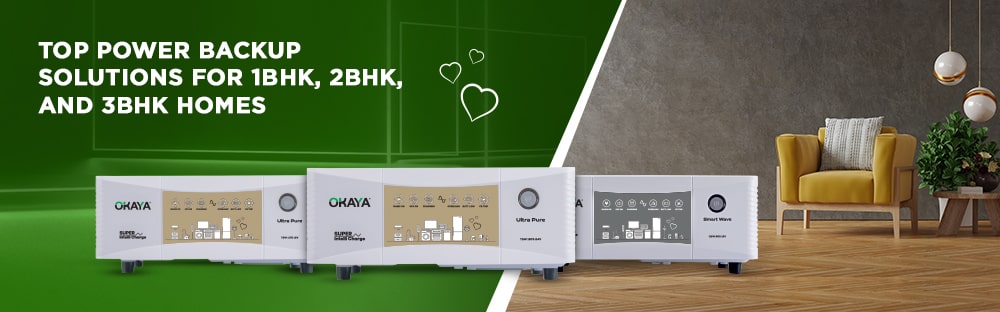
The right power backup depends on how many appliances you run during a cut, not only on the size of your home. A 1BHK with lights, fans and a TV needs far less than a 3BHK with a refrigerator, a mixer and a water pump. This guide matches Okaya's Home UPS and inverter battery options to each home size, so you can pick a setup that covers your load. If you are choosing an inverter for home use, start with the quick table below and then read the section for your home size.
Okaya's guidance, based on its Home UPS range of 700 VA to 2000 VA and its inverter batteries of 90 Ah to 310 Ah, is summarised below. It is a starting point, not a fixed rule, because your actual appliances decide the final choice.
|
Home size |
Typical loads |
Home UPS capacity |
System voltage |
Battery capacity |
Batteries needed |
|
1BHK |
Lights, fans, TV, Wi-Fi |
700 to 925 VA |
12V |
90 to 110 Ah |
1 |
|
2BHK |
Above, plus mixer and, with a larger setup, a refrigerator |
925 to 1450 VA |
12V |
110 to 160 Ah |
1 |
|
3BHK |
Above, plus refrigerator, washing machine and more fans |
1450 to 2000 VA |
12V or 24V |
160 to 210 Ah |
1 (12V) or 2 (24V) |
|
3BHK with AC, or larger homes |
Air conditioner, heavy kitchen or pump loads |
2500 VA and above (Hi-Capacity UPS) |
24V or 48V |
As advised for the model |
2 (24V) or 4 (48V) |
The voltage rule is simple: a 12V system uses one 12V battery, a 24V system uses two, and a 48V system uses four. For a wider view of the options, see Okaya's range of power backup for home solutions.
Whatever your home size, the method is the same. Add the running wattage of the appliances you want to use together, then divide by the power factor. For simple home-inverter sizing, a power factor of around 0.8 is commonly used as a working estimate, although the actual power factor can vary by appliance and load. Then choose the next available capacity above the result.
Example for a small flat: 2 fans at 80 W, 4 LED lights at 15 W and a TV at 100 W add up to 370 W. 370 W ÷ 0.8 ≈ 463 VA, so the next available 700 VA Home UPS provides additional headroom. Motors and compressors, such as in a refrigerator or a pump, draw more at startup, so leave extra margin when they are on your list.
The complete method, with more worked examples, is in the guide on how to choose the right inverter VA for your home. You can also use Okaya's load calculator to check your total.
1. A 1BHK usually runs a few lights, two or three fans, a TV and a Wi-Fi router. Okaya's 700 VA (560 W) and 925 VA (740 W) Home UPS models are built for this kind of load. Both are 12V, so they need a single battery.
2. Choose 700 VA if your load is limited to lights, fans and a TV.
3. Choose 925 VA if you also run a laptop, a second TV or a few extra fans, or if you expect to add appliances later.
4. Pair it with a 90 Ah battery for compact needs, or move up to 110 Ah if you want longer backup.
Both models use Advanced True Sine Wave (ATSW) technology, which gives smooth, grid-like output for fans, TVs and chargers.
A 2BHK adds a second bedroom, more fans and often a mixer or a small refrigerator. For a standard 2BHK with lights, fans and a TV, the 925 VA model is a workable starting point. If you want to run a mixer, Okaya's solution page points to the 1150 VA model, and for a refrigerator it points to the 1150 VA or 1450 VA models with a battery of 160 Ah or larger. For a refrigerator, the 1450 VA model suits an inverter for 2bhk flat setup, since it leaves more room for startup surges.
For battery capacity, Okaya suggests around 160 Ah for a 2BHK home, and 110 Ah to 140 Ah can work where the load is lighter. A larger battery gives longer backup at the same load.
1. A 3BHK typically has more fans and lights, a refrigerator, a washing machine and sometimes a water pump or a second TV. Okaya's guidance for this load is 1450 VA to 2000 VA. The 1450 VA model runs on 12V with one battery, while the 1650 VA and 2000 VA models run on 24V with two batteries.
2. 1450 VA is a fit for a refrigerator, fans, TV and lights running together, provided the total stays within the rating.
3. 1650 VA and 2000 VA give more room when you run more appliances at once.
4. For batteries, Okaya suggests 160 Ah to 210 Ah for most 3BHK loads, and 210 Ah or more for longer backup.
Check the Certified Backup Hours (CBH) printed on the battery pack against your combined wattage, since backup time depends on how much load you connect.
A standard Home UPS is generally not recommended for running an air conditioner. For AC loads, consider the Hi-Capacity UPS range, which runs from 2500 VA to 6100 VA with a 36-month warranty, and select the model based on the AC's running wattage, startup surge and any other loads connected at the same time. These models use 24V or 48V systems, so they need two or four 12V batteries. Confirm the final choice with a dealer before buying.
Backup time depends on battery capacity and the load you connect. Okaya publishes Certified Backup Hours (CBH) for its inverter batteries, tested under UMHD conditions in NABL-accredited labs. The table below shows a few capacities from the CBH reference at constant loads. Real backup varies with your appliances, the battery's age and how often the power goes out. See the full table on the CBH page.
|
Series |
Ah |
Type |
Warranty (months) |
400 W |
300 W |
200 W |
100 W |
|
PowerOn |
90 |
JXT |
48 (24+24) |
1:15 |
1:45 |
3:25 |
8:10 |
|
PowerOn |
110 |
SJT |
48 (24+24) |
1:45 |
2:45 |
4:55 |
11:30 |
|
PowerOn |
160 |
SJT |
48 (24+24) |
3:00 |
4:30 |
7:50 |
17:20 |
|
PowerOn |
210 |
TT |
48 (24+24) |
4:30 |
6:40 |
11:25 |
24:50 |
To compare capacities and formats, see Okaya's inverter batteries, and read which inverter battery is best for home for how Ah, battery type and warranty fit different homes.
Fans, refrigerators, TVs and laptop chargers contain motors or sensitive electronics. A sine wave output is closer to grid power, so these appliances run smoothly. Okaya's current Home UPS and Hi-Capacity UPS models use Advanced True Sine Wave (ATSW) technology.
Okaya lists these protections on its product pages: overload, low-battery, high-battery, short-circuit and over-temperature protection. Exact protections vary by model, so check the product page of the one you choose.
Home UPS and Hi-Capacity UPS models carry a 36-month warranty, and Okaya inverter batteries carry 48 to 66 months depending on the model. For help choosing a model, call Okaya Care on +91 9818 909090, write to care@okaya.in, or find a nearby outlet through the dealer locator.
For lights, fans, a TV and Wi-Fi, Okaya's 700 VA or 925 VA Home UPS paired with a single 90 Ah to 110 Ah battery is a suitable starting point. Choose 925 VA if you may add appliances later.
Which inverter is suitable for a 2BHK flat?
A 925 VA model covers basic lights, fans and a TV. If you run a mixer or a refrigerator, Okaya points to the 1150 VA or 1450 VA models with a 160 Ah or larger battery.
What inverter capacity do I need for a 3BHK house?
Okaya's guidance is 1450 VA to 2000 VA for a refrigerator, fans, TV and lights. Add up your actual running watts and allow margin for motor startup before deciding.
Can an inverter run a refrigerator?
Yes, if the refrigerator and other connected loads are within the inverter's rating and the battery capacity. Okaya suggests at least a 1150 VA model with a 160 Ah or larger battery for a refrigerator, and a refrigerator's startup draw is higher than its running load.
Can a Home UPS run an air conditioner?
A standard Home UPS is generally not recommended for running an air conditioner. For AC loads, consider the Hi-Capacity UPS range and select the model based on the AC's running wattage, startup surge and any other loads connected at the same time.
Which battery capacity is right for a 2BHK home?
Okaya suggests around 160 Ah for a 2BHK, with 110 Ah to 140 Ah for lighter loads. A larger battery gives longer backup at the same load.
How many batteries does my inverter need?
A 12V inverter uses one 12V battery, a 24V inverter uses two, and a 48V inverter uses four.
How long will a battery run my home appliances?
It depends on battery capacity and the connected load. Check the Certified Backup Hours (CBH) on the battery pack, which are tested at constant loads, and compare them with your combined wattage.
What is the warranty on Okaya Home UPS and batteries?
Home UPS models carry a 36-month warranty. Okaya inverter batteries carry 48 to 66 months depending on the model.
To see current options, check the home inverter price for the full Home UPS range, or the 1 kva inverter price for the 1150 VA model on the Okaya shop.
If you are comparing a full setup for a flat, the shop's 2BHK page lists inverter and battery options, including the inverter cost for 2bhk for the models Okaya suggests.
 OKAYA POWER PVT. LTD.
ENERGIS D-7, 3rd & 4th Floor, Rohtak Rd,
Udyog Nagar, Mangolpuri,
New Delhi - 110041, INDIA
© 2026 All Rights Reserved to Okaya Power Private Limited