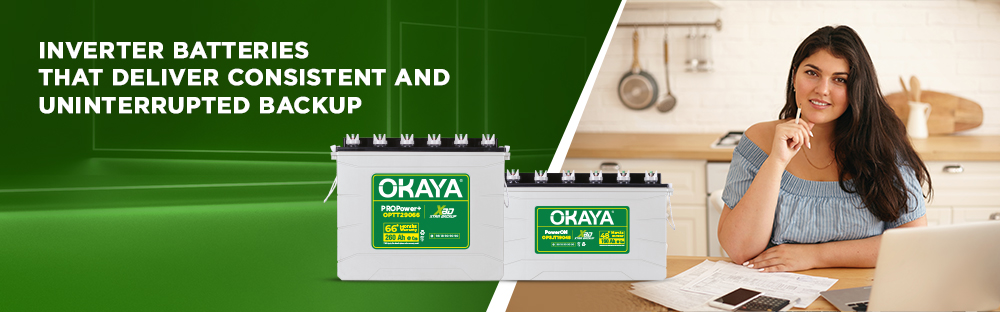
Consistent backup comes from four things working together: a capacity that matches your load, backup hours that are tested and declared rather than estimated from Ah alone, a battery that is kept charged and topped up, and support when you need it. This guide explains how Okaya's current range of tubular batteries, an inverter battery for home and business backup, covers each of the four, from 90Ah to 310Ah.
Backup is consistent when these four things line up:
A. Capacity matched to your load, so the battery is not asked to run more than it was chosen for.
B. Declared backup hours at a load close to yours, instead of an Ah figure alone.
C. A battery that is recharged between power cuts and checked for water level.
D. Warranty and service you can reach if something goes wrong.
Use declared backup hours at a known load. Okaya's Certified Backup Hours are tested under the UMHD (Urban Metro Heavy Duty) load cycle in NABL-accredited laboratories and printed on the packaging, and why Certified Backup Hours matter in inverter batteries explains how to read them. Examples, in hours:minutes:
A. 90Ah, 48 months (24+24): 3:25 at 200 W, 8:10 at 100 W.
B. 160Ah TT, 60 months (36+24): 8:45 at 200 W, 20:15 at 100 W.
C. 210Ah TT, 60 months (36+24): 12:05 at 200 W, 28:10 at 100 W.
D. 260Ah TT, 66 months (42+24): 15:05 at 200 W, 32:40 at 100 W.
E. 310Ah TT, 60 months (36+24): 6:40 at 400 W, 9:45 at 300 W.
The 310Ah model is tested at higher loads (600 W to 300 W), so its figures are not directly comparable with the others. Okaya states that XBD+ gives up to 15 to 20% longer backup than a conventional tubular battery of the same Ah capacity, and that real backup varies with temperature, battery age, the inverter used and state of charge.
Add up the wattage you want to run with the inverter power calculator, then compare the inverter battery capacity of each model. Okaya's current range runs from 90Ah to 310Ah, and it suggests 90Ah for compact needs, 160Ah for a typical 2BHK, 210Ah for larger homes that need longer backup, 260Ah for heavy loads and 310Ah for commercial use. For the full calculation, read how to choose the best inverter battery.
Yes, because backup also varies with the battery's state of charge. Okaya states that its SJT batteries recharge about 15% faster than conventional Jumbo Tubular batteries. That figure is not a comparison with TT, and the inverter's charging also affects how quickly a battery recovers.
Okaya states that most models need only 1 to 2 water top-ups a year. Six ceramic water-level indicators let you check levels without opening the cell. SJT batteries have all water inlets on one side in a 6x1 layout, and Okaya's SJT product page lists a vent-plug and float design.
Use the water specified in the product manual or by Okaya Care for your model, and top up only when the indicators show a low level. If you are unsure, confirm with Okaya Care before topping up.
Total warranty runs from 48 to 66 months depending on the model, made up of a flat period and a pro-rata period. Warranty registration is paperless, and Okaya lists an all-India onsite service network. For help, message Okaya Care on WhatsApp at +91 9818 909090 or write to care@okaya.in, and use the dealer locator to find nearby Okaya dealers in your area.
How can I get consistent backup from an inverter battery?
Match the capacity to your load, compare declared backup hours at a load close to yours, keep the battery charged and check water levels, and register the warranty.
How many hours of backup does an Okaya inverter battery give?
It depends on the capacity and the load. For example, the 160Ah TT with a 60-month warranty is certified at 8:45 at 200 W and 20:15 at 100 W. Real backup varies with temperature, battery age and the inverter used.
Which Okaya inverter battery is right for my home?
Okaya suggests around 160Ah for a typical 2BHK, 210Ah for larger homes that need longer backup and 260Ah for heavy loads. Add up your wattage to confirm.
What capacities does Okaya's inverter battery range cover?
The current range runs from 90Ah to 310Ah across 13 models, with total warranties of 48 to 66 months.
How often does an Okaya inverter battery need water?
Okaya states that most models need only 1 to 2 top-ups a year. Six ceramic water-level indicators help you check levels.
Does an inverter battery need distilled water?
Use the water specified in the product manual or by Okaya Care for your model. Confirm with Okaya Care if you are unsure.
What are Certified Backup Hours?
They are backup times Okaya declares at set loads, tested under the UMHD load cycle in NABL-accredited laboratories and printed on the packaging.
How do I contact Okaya for battery support?
Message Okaya Care on WhatsApp at +91 9818 909090 or write to care@okaya.in. You can also use the dealer locator on okaya.in to find nearby Okaya dealers in your area.
To compare the current UPS battery price, Okaya battery price and home UPS battery price across capacities, visit the Okaya shop.
 OKAYA POWER PVT. LTD.
ENERGIS D-7, 3rd & 4th Floor, Rohtak Rd,
Udyog Nagar, Mangolpuri,
New Delhi - 110041, INDIA
© 2026 All Rights Reserved to Okaya Power Private Limited