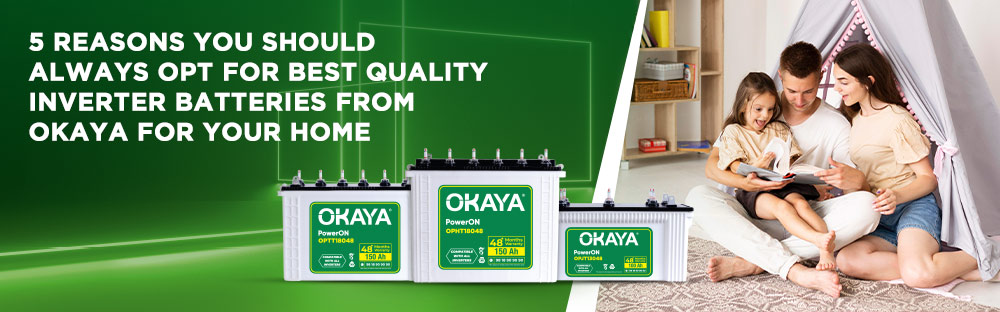
A quality inverter battery is one you can verify: tested backup hours, clear maintenance needs, a defined warranty, suitable recharge performance and a design that adds backup. These checks help determine how well the battery fits your home backup needs, and each is explained below with the figures Okaya publishes for its inverter batteries.
It does when the backup is tested and declared, not just described. Okaya's Certified Backup Hours are printed on the packaging for each model at set loads, so you can match a battery to the appliances you need to run. The 160Ah SJT battery with a 60-month warranty, for example, is certified at 8:00 at 200 W and 18:40 at 100 W. Add up your fans, lights and router first, and an inverter power calculator will give you a load figure to compare against these hours.
Yes, when the design reduces routine work. Okaya states that most of its models need water topping once or twice a year. On the checked 160Ah SJT product page, Okaya lists a vent plug that prevents spills, a float design that allows topping without removing the float plug, and six ceramic water-level indicators that show the level at a glance. Use the water type specified in your product manual or by Okaya Care.
Durability shows up as a defined warranty and service life. Okaya's inverter batteries carry a total warranty of 48 to 66 months, split into a flat period and a pro-rata period; a 60-month model, for instance, has 36 months flat and 24 pro-rata. Okaya states a service life of 4 to 6 years. How long a battery lasts in practice depends on charging, load and care, which the inverter battery care guide covers.
Recharge speed matters most where power cuts are short and frequent, because the battery has to be ready again before the next cut. Okaya states that its SJT batteries charge about 15% faster than a conventional Jumbo Tubular battery. Charging also depends on the inverter's charger, so check both when you shop.
Design can add backup without adding Ah. Okaya states that its XBD+ technology gives up to 15 to 20% longer backup than a conventional tubular battery of the same Ah capacity. For safety, Okaya lists corner and terminal protection on its 160Ah SJT and TT batteries. Have the battery fitted through your dealer as covered in the inverter battery installation guide, and do not rewire terminals unless you are trained.
Match the battery's voltage to the inverter first: one 12V battery for a 12V inverter, two identical batteries in series for 24V and four for 48V. Then choose the capacity from your load and the backup hours you want. Okaya suggests 90Ah for compact needs, 160Ah for a typical 2BHK home, 210Ah for larger homes or longer backup and 260Ah for heavy loads. How to choose the best inverter battery walks through the full process.
How can I tell if an inverter battery is good quality before buying?
Look for backup hours declared at specific loads, the test conditions behind them, a written warranty with its flat and pro-rata split, and a service network. If a battery offers only adjectives and no figures, you cannot compare it.
Is a higher Ah battery always better quality?
No. Ah is capacity, not quality. Two batteries of the same Ah can give different backup hours, so compare the declared hours at your own load.
Will a good battery work with any inverter?
Only if the voltage matches. A 12V inverter takes one battery, a 24V inverter two identical batteries in series and a 48V inverter four. Check your inverter's rated voltage before choosing.
How much maintenance does a tubular battery need?
Okaya states that most of its models need water topping once or twice a year. Check the level against the indicators and use the water type your product manual specifies.
What do flat and pro-rata warranty periods mean?
Okaya's total warranty is made up of a flat period followed by a pro-rata period; a 60-month model has 36 months flat and 24 pro-rata. Okaya Care assesses each claim, so keep your purchase details and warranty registration handy.
Should I choose a bigger battery for frequent short power cuts?
Not necessarily. Short cuts need a battery that recharges between them, so charging speed and the inverter's charger matter as much as capacity. Size the battery to your load and the longest cut you expect.
To see the full Okaya range, visit the Okaya inverter battery shop, or use the dealer locator to find a dealer who can fit the battery.
 OKAYA POWER PVT. LTD.
ENERGIS D-7, 3rd & 4th Floor, Rohtak Rd,
Udyog Nagar, Mangolpuri,
New Delhi - 110041, INDIA
© 2026 All Rights Reserved to Okaya Power Private Limited